
ASTM B575
- Home
- Products
- Alloy Steel Stocks
- ASTM B575
ASTM B575 Basic Info
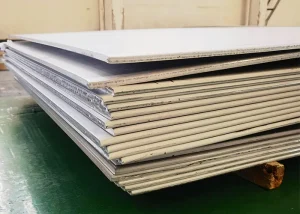
ASTM B575, a pivotal standard from ASTM International, delineates the requirements for nickel-chromium-molybdenum-copper alloy (UNS N10276) plate, sheet, and strip. This specification meticulously details essential factors such as chemical composition, mechanical properties, and dimensional tolerances, fostering consistency and quality assurance in diverse applications.
Characteristics of ASTM B575
- High-Strength: ASTM B575 steel exhibits high-strength properties, making it suitable for applications where durability and structural integrity are crucial.
- Resistance to Pitting and Crevice Corrosion: This steel is particularly known for its resistance to pitting and crevice corrosion, which can occur in chloride-rich environments.
- Resistance to Stress Corrosion Cracking: ASTM B575 steel has excellent resistance to stress corrosion cracking, a type of corrosion that can occur under tensile stress in the presence of corrosive media.
- Wide Application Range: Due to its combination of corrosion resistance and strength, ASTM B575 steel finds applications in various industries such as chemical processing, pollution control, waste treatment, and more.
ASTM B575 Data Sheet
Steel Grade
Dimensions and Tol.
Equivalent Steel Grades
Chemical Composition
Mechanical Properties
Fabrication and Welding
Steel Grade
B575 UNS N06022: Hastelloy C-22
B575 UNS N10276: Hastelloy C-276
B575 UNS N10665: Hastelloy B-2
B575 UNS N06030: Hastelloy G-30
B575 UNS N06455: Hastelloy C-4
B575 UNS N06985: Hastelloy G-35
Dimensions and Tol.
Thickness:
- Specification: 0.025″ to 1.00″ (0.64 mm to 25.4 mm)
- Tolerance: +0.125″/-0″ (3.2 mm/-0 mm)
Width:
- Specification: 12″ to 48″ (305 mm to 1220 mm)
- Tolerance: +0.250″/-0″ (6.4 mm/-0 mm)
Length:
- Specification: 12″ to 144″ (305 mm to 3658 mm)
Equivalent Steel Grades
B575 UNS N06022:
Germany: DIN NiCr21Mo14W (2.4602)
Japan: JIS NW6022
China: GB NS3308
UK: BS NA41
B575 UNS N10276:
Germany: DIN NiMo16Cr15Ti (2.4819)
Japan: JIS NW0276
China: GB NS3344
UK: BS NA42
B575 UNS N10665:
Germany: DIN NiCr20Mo18W (2.461)
Japan: JIS NW0665
China: GB NS3345
UK: BS NA44
B575 UNS N06030:
Germany: DIN NiCr15Fe (2.4856)
Japan: JIS NW0800
China: GB NS3308
UK: BS NA46
B575 UNS N06455:
Germany: DIN NiCr24Mo15W (2.4669)
Japan: JIS NW0645
China: GB NS3355
UK: BS NA57
B575 UNS N06985:
Germany: DIN NiCr23Mo16W (2.4667)
Japan: JIS NW0698
China: GB NS3369
UK: BS NA69
Chemical Composition
Hastelloy C-22 (N06022):
Nickel (Ni): 56.0 – 62.0%
Chromium (Cr): 20.0 – 22.5%
Molybdenum (Mo): 12.5 – 14.5%
Iron (Fe): 2.00% max
Tungsten (W): 2.50% max
Cobalt (Co): 2.50% max
Manganese (Mn): 0.50% max
Vanadium (V): 0.35% max
Silicon (Si): 0.08% max
Carbon (C): 0.01% max
Phosphorus (P): 0.02% max
Sulfur (S): 0.02% max
Hastelloy C-276 (N10276):
Nickel (Ni): 55.0% min
Chromium (Cr): 14.5 – 16.5%
Molybdenum (Mo): 15.0 – 17.0%
Iron (Fe): 4.0 – 7.0%
Tungsten (W): 3.0 – 4.5%
Cobalt (Co): 2.50% max
Manganese (Mn): 1.0% max
Silicon (Si): 0.08% max
Carbon (C): 0.01% max
Phosphorus (P): 0.04% max
Sulfur (S): 0.03% max
Hastelloy B-2 (N10665):
Nickel (Ni): 50.0% min
Chromium (Cr): 1.0% max
Molybdenum (Mo): 26.0 – 30.0%
Iron (Fe): 2.0% max
Cobalt (Co): 1.0% max
Manganese (Mn): 1.0% max
Silicon (Si): 0.10% max
Carbon (C): 0.02% max
Phosphorus (P): 0.04% max
Sulfur (S): 0.03% max
Hastelloy G-30 (N06030):
Nickel (Ni): 59.0% min
Chromium (Cr): 29.0 – 31.5%
Molybdenum (Mo): 4.0% max
Iron (Fe): 5.0% max
Tungsten (W): 1.0 – 3.0%
Cobalt (Co): 2.50% max
Manganese (Mn): 1.50% max
Silicon (Si): 0.15% max
Carbon (C): 0.03% max
Phosphorus (P): 0.04% max
Sulfur (S): 0.03% max
Hastelloy C-4 (N06455):
Nickel (Ni): 65.0% min
Chromium (Cr): 14.0 – 18.0%
Molybdenum (Mo): 14.0 – 18.0%
Iron (Fe): 3.0% max
Cobalt (Co): 2.0% max
Manganese (Mn): 1.0% max
Silicon (Si): 0.08% max
Carbon (C): 0.01% max
Phosphorus (P): 0.04% max
Sulfur (S): 0.03% max
Hastelloy G-35 (N06035):
Nickel (Ni): 37.0 – 42.0%
Chromium (Cr): 19.0 – 21.5%
Molybdenum (Mo): 8.0 – 11.0%
Iron (Fe): 20.0% min
Cobalt (Co): 1.0% max
Silicon (Si): 0.30% max
Carbon (C): 0.02% max
Phosphorus (P): 0.04% max
Sulfur (S): 0.03% max
Copper (Cu): 1.80 – 2.60%
Mechanical Properties
Tensile Strength: 690 MPa (100 ksi)
Yield Strength (0.2% Offset): 310 MPa (45 ksi)
Elongation (in 50mm): 45% min
Reduction of Area: 45% min
Hardness, Rockwell B: 89 max
Fabrication and Welding
Hot Working:
Hot working of ASTM B575 material can be done in the temperature range of 1600°F to 2250°F (870°C to 1230°C).
Cold Working:
Cold working is performed by methods such as cold rolling, deep drawing, and press forming. ASTM B575 material can be cold worked in the annealed condition.
Welding Methods:
Common welding methods for ASTM B575 include Gas Tungsten Arc Welding (GTAW or TIG), Gas Metal Arc Welding (GMAW or MIG), Shielded Metal Arc Welding (SMAW or Stick), and Submerged Arc Welding (SAW).
Welding Consumables:
- For GTAW (TIG) welding, use ERNiCrMo-10 or ERNiCrMo-4 filler metals.
- For GMAW (MIG) welding, use ERNiCrMo-4 or ENiCrMo-4 filler metals.
- For SMAW (Stick) welding, use ENiCrMo-10 or ENiCrMo-4 electrodes.
- For SAW (Submerged Arc) welding, use ENiCrMo-10 or ENiCrMo-4 wire.
Welding Preheat: Preheating is generally not required for ASTM B575. However, preheat to 200°F (93°C) may be beneficial for thick sections or when the material is at a low temperature.
Post Weld Heat Treatment (PWHT): Generally not required for ASTM B575, unless specified by the customer or for specific applications.
Interpass Temperature Control: Maintain interpass temperatures between 200°F and 400°F (93°C and 204°C) during welding.
Post Weld Cleaning: Remove all slag, spatter, and weld heat tint from the welded area after completion of welding.
Inspection and Testing:
Conduct visual inspection, liquid penetrant testing (LPT), and radiographic testing (RT) as needed to ensure quality. Ultrasonic testing (UT) may be used for thicker sections.
ASTM B575 VS. ASTM B574
ASTM B575:
- Alloys Covered: Nickel-molybdenum-chromium-iron alloys (UNS N10276, N06022, etc.)
- Forms Covered: Plate, Sheet, Strip
- Primary Use: Corrosion resistance in various environments
- Specifications: Chemical composition, mechanical properties, other requirements
- Examples of Alloys: Hastelloy C276, Hastelloy C22, Hastelloy C4, Inconel 625, etc.
ASTM B574:
- Alloys Covered: Nickel-chromium-molybdenum-columbium (niobium) alloys (UNS N06607, etc.)
- Forms Covered: Rod, Bar, Wire, Forging Stock
- Primary Use: High-temperature applications
- Specifications: Chemical composition, mechanical properties, dimensions, tolerances
- Examples of Alloys: Hastelloy B2, Hastelloy C4, Hastelloy C22, Inconel 600, etc.