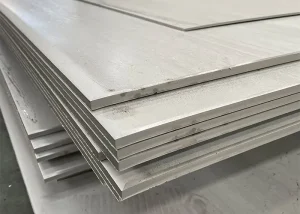

ASTM A240
- Home
- Products
- Stainless Steel Stocks
- ASTM A240
Characteristics
Corrosion Resistance: ASTM A240 steel exhibits excellent resistance to corrosion, making it suitable for use in various environments, including those exposed to moisture, chemicals, and high temperatures.
Versatility: ASTM A240 covers a wide range of grades and finishes, offering versatility in applications. This allows for the selection of the most appropriate stainless steel grade and surface finish to meet specific requirements in different industries and applications.
ASTM A240 Data Sheet
Steel Grade
Dimensions and Tolerances
Equivalent Grades
Chemical Composition
Mechanical Properties
Corrosion Resistance
Fabrication and Welding
Steel Grade
304/304L
316/316L
321
347
410
430
Dimensions and Tolerances
Sheet
Width Range (inches): Up to 96
Thickness Range (inches): 0.018 to 0.135
Tolerances: Width: +/- 0.015 inches, Thickness: +/- 0.005 inches
Plate
Width Range (inches): Up to 120
Thickness Range (inches): 0.1875 to 4.000
Tolerances: Width: +/- 0.0625 inches, Thickness: +/- 0.030 inches
Strip
Width Range (inches): Up to 72
Thickness Range (inches): 0.005 to 0.130
Tolerances: Width: +/- 0.005 inches, Thickness: +/- 10%
Equivalent Grades
United States (USA)
Equivalent Grade(s): UNS S30400/S30403, UNS S31600/S31603, UNS S32100, UNS S34700, UNS S41000, UNS S43000
Standard: ASTM A240/A240M
European Union (EU)
Equivalent Grade(s): X5CrNi18-10, X2CrNi19-11, X5CrNiMo17-12-2, X2CrNiMo17-12-2, X6CrNiTi18-10, X6CrNiNb18-10, X6Cr17
Standard: EN 10088-2
Japan
Equivalent Grade(s): SUS304/SUS304L, SUS316/SUS316L, SUS321, SUS347, SUS410, SUS430
Standard: JIS G4304/G4305
China
Equivalent Grade(s): 06Cr19Ni10/03Cr19Ni9, 06Cr17Ni12Mo2/022Cr17Ni12Mo2, 06Cr18Ni11Ti, 06Cr18Ni11Nb, 1Cr17
Standard: GB/T 4237
Chemical Composition
304/L
Carbon (C): 0.08 max
Manganese (Mn): 2.00 max
Phosphorus (P): 0.045 max
Sulfur (S): 0.030 max
Silicon (Si): 0.75 max
Chromium (Cr): 18.0-20.0
Nickel (Ni): 8.0-10.5
316/L
Carbon (C): 0.08 max
Manganese (Mn): 2.00 max
Phosphorus (P): 0.045 max
Sulfur (S): 0.030 max
Silicon (Si): 0.75 max
Chromium (Cr): 16.0-18.0
Nickel (Ni): 10.0-14.0
Molybdenum (Mo): 2.0-3.0
321
Carbon (C): 0.08 max
Manganese (Mn): 2.00 max
Phosphorus (P): 0.045 max
Sulfur (S): 0.030 max
Silicon (Si): 0.75 max
Chromium (Cr): 17.0-19.0
Nickel (Ni): 9.0-12.0
347
Carbon (C): 0.08 max
Manganese (Mn): 2.00 max
Phosphorus (P): 0.045 max
Sulfur (S): 0.030 max
Silicon (Si): 0.75 max
Chromium (Cr): 17.0-19.0
Nickel (Ni): 9.0-13.0
410
Carbon (C): 0.15 max
Manganese (Mn): 1.00 max
Phosphorus (P): 0.040 max
Sulfur (S): 0.030 max
Silicon (Si): 1.00 max
Chromium (Cr): 11.5-13.5
430
Carbon (C): 0.12 max
Manganese (Mn): 1.00 max
Phosphorus (P): 0.040 max
Sulfur (S): 0.030 max
Silicon (Si): 1.00 max
Chromium (Cr): 16.0-18.0
Mechanical Properties
Tensile Strength (ksi)
ASTM A240 Grade 304/L: 75 min
ASTM A240 Grade 316/L: 75 min
ASTM A240 Grade 321: 75 min
ASTM A240 Grade 347: 75 min
ASTM A240 Grade 410: 65 min
ASTM A240 Grade 430: 70 min
Tensile Strength (MPa)
ASTM A240 Grade 304/L: 515 min
ASTM A240 Grade 316/L: 515 min
ASTM A240 Grade 321: 515 min
ASTM A240 Grade 347: 515 min
ASTM A240 Grade 410: 450 min
ASTM A240 Grade 430: 485 min
Yield Strength (ksi)
ASTM A240 Grade 304/L: 30 min
ASTM A240 Grade 316/L: 30 min
ASTM A240 Grade 321: 30 min
ASTM A240 Grade 347: 30 min
ASTM A240 Grade 410: 30 min
ASTM A240 Grade 430: 30 min
Yield Strength (MPa)
ASTM A240 Grade 304/L: 205 min
ASTM A240 Grade 316/L: 205 min
ASTM A240 Grade 321: 205 min
ASTM A240 Grade 347: 205 min
ASTM A240 Grade 410: 205 min
ASTM A240 Grade 430: 205 min
Elongation (%)
ASTM A240 Grade 304/L: 40 min
ASTM A240 Grade 316/L: 40 min
ASTM A240 Grade 321: 40 min
ASTM A240 Grade 347: 40 min
ASTM A240 Grade 410: 20 min
ASTM A240 Grade 430: 25 min
Rockwell Hardness (B)
ASTM A240 Grade 304/L: 92 max
ASTM A240 Grade 316/L: 95 max
ASTM A240 Grade 321: 90 max
ASTM A240 Grade 347: 90 max
ASTM A240 Grade 410: 88 max
ASTM A240 Grade 430: 85 max
Corrosion Resistance
Stainless Steel Grade: ASTM A240 encompasses various stainless steel grades, each offering different levels of corrosion resistance. Grades such as 304, 316, and 321 are known for their excellent corrosion resistance in a wide range of environments.
Alloy Composition: The alloy composition of ASTM A240 stainless steel plays a crucial role in its corrosion resistance. Elements like chromium, nickel, molybdenum, and nitrogen enhance the steel’s ability to resist corrosion, particularly in harsh environments.
Surface Finish: The surface finish of stainless steel, specified in ASTM A240, can impact its corrosion resistance. Smooth, polished surfaces with low roughness can inhibit corrosion by minimizing areas for corrosion initiation and promoting passive film formation.
Environmental Exposure: The type and severity of environmental exposure significantly influence the corrosion resistance requirements of ASTM A240 stainless steel. Factors such as temperature, humidity, pH, chloride concentration, and exposure to chemicals must be considered when selecting the appropriate grade.
Maintenance and Protection: Regular maintenance and appropriate protection measures are essential for maximizing the corrosion resistance of ASTM A240 stainless steel. This may include routine cleaning, surface treatments, coatings, and cathodic protection methods.
Fabrication and Welding
Formability: ASTM A240 stainless steel grades show good formability, allowing for various fabrication processes such as bending, punching, and cutting.
Machinability: These grades generally have good machinability, although adjustments to tooling and machining parameters may be required for optimal performance.
Weldability: ASTM A240 stainless steel grades are weldable using common methods like TIG, MIG, and SMAW.
Preheating and Interpass Temperature: Preheating and control of interpass temperature might be necessary for thicker sections or specific grades to minimize cracking during welding.
Post-Weld Heat Treatment (PWHT): Some grades may require post-weld heat treatment to restore mechanical properties and relieve residual stresses, especially in critical applications.
Welding Consumables: Matching filler metals and electrodes should be selected to ensure compatibility and optimize weld quality.
Welding Procedure Qualification (WPQ): Welding procedures should be qualified by testing to comply with relevant standards, especially for critical applications.
Weld Inspection and Quality Assurance: Welds should undergo inspection using appropriate non-destructive testing (NDT) methods such as visual inspection, radiography, ultrasonic testing, or dye penetrant testing.
Surface Preparation: Proper surface preparation, including cleaning and removal of surface contaminants, is essential to ensure sound welds and minimize the risk of defects.