
ASTM B670
- Home
- Products
- Alloy Steel Stocks
- ASTM B670
ASTM B670 Basic Info
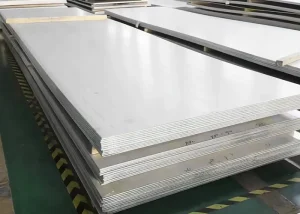
ASTM B670 offers a comprehensive framework for titanium and titanium alloy (Grade 2 and Grade 12) plate, sheet, and strip materials, ensuring their suitability for various demanding applications. By specifying crucial parameters like chemical composition, mechanical properties, and manufacturing processes, this standard facilitates consistent quality and performance. Industries ranging from aerospace and medical to marine engineering benefit from the reliability and compatibility ensured by ASTM B670, streamlining production processes and enhancing product reliability.
Characteristics of ASTM B670
- Mechanical Properties: Outlines the mechanical characteristics such as tensile strength, yield strength, elongation, and hardness that the alloy should exhibit under specific conditions.
- Heat Treatment Requirements: Defines the heat treatment processes necessary to achieve the desired microstructure and properties in the finished alloy.
- Surface Finish: Specifies the acceptable surface finish standards for Inconel 718 products to ensure they meet visual and functional requirements.
- Dimensions and Tolerances: Provides guidelines on dimensions, sizes, and tolerances for various forms of Inconel 718, such as plates, sheets, strips, and bars, ensuring uniformity in manufacturing and compatibility with end-use applications.
ASTM B670 Data Sheet
Dimensions and Tol.
Equivalent Steel Grades
Chemical Composition
Mechanical Properties
Fabrication and Welding
Dimensions and Tol.
Sheet:
- Width: 36 in. (914 mm) max; ±0.030 in. (0.76 mm)
- Thickness: 0.010 to 0.249 in. (0.25 to 6.32 mm); ±10% or ±0.001 in. (0.025 mm)
Plate:
- Width: 36 in. (914 mm) max
- Thickness: 0.250 to 4.00 in. (6.35 to 101.6 mm); ±10% or ±0.010 in. (0.25 mm)
Strip:
- Width: 36 in. (914 mm) max; ±0.030 in. (0.76 mm)
- Thickness: 0.010 to 0.249 in. (0.25 to 6.32 mm); ±10% or ±0.001 in. (0.025 mm)
Bar and Rod:
- Diameter: 12 ft (3.7 m) max; ±0.005 in. (0.13 mm)
- Thickness: 0.250 to 10.00 in. (6.35 to 254 mm); ±0.005 in. (0.13 mm)
- Length: ±1/8 in. (3.2 mm)
Equivalent Steel Grades
Germany:
Equivalent Steel Grade: 2.4668 (NiCr19Fe19Nb5Mo3)
Japan:
Equivalent Steel Grade: NCF 718
China:
Equivalent Steel Grade: GH4169
UK:
Equivalent Steel Grade: NA 51
Chemical Composition
Nickel (Ni): 50.00 – 55.00%
Chromium (Cr):17.00 – 21.00%
Iron (Fe):Balance
Molybdenum (Mo):2.80 – 3.30%
Niobium (Nb):4.75 – 5.50%
Titanium (Ti):0.65 – 1.15%
Aluminum (Al):0.20 – 0.80%
Cobalt (Co):1.00% max
Carbon (C):0.08% max
Manganese (Mn): 0.35% max
Silicon (Si):0.35% max
Sulfur (S):0.015% max
Phosphorus (P): 0.015% max
Mechanical Properties
Tensile Strength, Yield:
- Value: 120,000 psi (827 MPa)
- Annealed Properties: 95,000 psi (655 MPa)
Tensile Strength, Ultimate:
- Value: 180,000 psi (1,241 MPa)
- Annealed Properties: 150,000 psi (1,034 MPa)
Elongation at Break:
- Value: 12%
- Annealed Properties: 30%
Reduction of Area:
- Value: 15%
- Annealed Properties: 45%
Hardness, Rockwell:
- Value: C35 HRc
- Annealed Properties: B95 HRb
Hardness, Brinell:
- Value: 331 HB
- Annealed Properties: 331 HB
Modulus of Elasticity:
- Value: 29,000,000 psi (200,000 MPa)
Poisson’s Ratio:
- Value: 0.296
Shear Modulus:
- Value: 11,000,000 psi (76,000 MPa)
Charpy V-notch Impact:
- Value: 100 J (74 ft-lbf)
Fabrication and Welding
Hot Working:
- Hot working should be performed at temperatures between 1700°F (927°C) and 1850°F (1010°C).
- Forging should be done at a starting temperature of 2050°F (1121°C) and finished at 1700°F (927°C) minimum.
- Annealing after hot working is recommended at a temperature of 1400°F (760°C) for at least 1 hour per inch (25.4 mm) of thickness.
Cold Working:
- Cold working can be performed using standard methods, but the alloy hardens quickly, so intermediate annealing may be required.
Machinability:
- Inconel 718 has good machinability in the annealed condition; carbide tools are recommended for turning, milling, and drilling.
Welding:
- Use appropriate welding methods such as gas tungsten arc, gas metal arc, or shielded metal arc welding.
- Preheating is recommended at 1200°F (650°C) and maintained during welding.
- Post-weld heat treatment is crucial for optimal properties; solution annealing at 1700°F (927°C) followed by aging at 1325°F (718°C).
- Welding rods or electrodes should match the alloy composition, such as AWS A5.14 ERNiFeCr-2 for Inconel 718.
- Avoid excessive heat input to prevent cracking; use interpass temperature control.
- Precautions should be taken to prevent contamination, such as from oils or cutting fluids, during welding.
- After welding, remove any scale and clean the weld area thoroughly to prevent corrosion.
Green Innovations: Sustainability of ASTM B670 Materials Examined
The sustainability of ASTM B670 materials is a burgeoning topic, showcasing their potential to align with eco-conscious initiatives. These materials, lauded for their corrosion resistance and durability, are under scrutiny for their environmental impact.
A crucial aspect is their lifecycle analysis, revealing opportunities for reduced resource consumption. Their recyclability is a key focus, exploring methods to reintegrate them into production cycles. Efforts are underway to assess energy efficiency, comparing them to conventional materials to potentially lower carbon footprints.
Innovations in coatings and treatments further enhance sustainability. These solutions not only extend material lifespan but also reduce maintenance needs, promoting longevity.
ASTM B670 materials present a promising avenue for industries seeking greener alternatives. As the drive for sustainability intensifies, these materials offer tangible benefits, paving the way for a more environmentally conscious future.