ASTM A285
- Home
- Products
- Carbon Steel Stocks
- ASTM A285
Basic Info
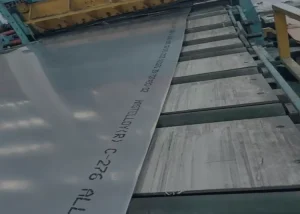
The ASTM A285 standard specifies the standard specifications for carbon steel plates used in low to medium temperature pressure vessels. These steel plates are commonly used in the manufacturing of oil and gas storage tanks, boilers, and other pressure vessels, and have good weldability and mechanical properties. This standard covers the chemical composition, mechanical properties, and dimensional requirements of steel plates, ensuring that products have the required strength and durability during use.
Characteristics
Pressure Vessel Grade: ASTM A285 steel is specifically designed for use in pressure vessel applications, making it suitable for storing and transporting liquids and gases under moderate to low pressures.
Three Grades: The specification includes three grades (A, B, and C), each offering different levels of tensile strength and yield strength to meet specific application requirements.
Weldability: ASTM A285 steel exhibits excellent weldability, allowing for ease of fabrication and the creation of complex structures without sacrificing integrity or performance.
Formability: This steel is known for its good formability, enabling it to be easily shaped and molded into various configurations during the manufacturing process.
Cost-Effective: ASTM A285 steel is often chosen for its cost-effectiveness, providing a balance between performance, durability, and affordability for pressure vessel applications.
Versatility: Due to its reliable performance and suitability for a wide range of pressure vessel applications, ASTM A285 steel is utilized across various industries, including oil and gas, chemical processing, and power generation.
ASTM A285 Data Sheet
Steel Grade
Dimensions and Tolerances
Equivalent Steel Grades
Chemical Composition
Mechanical Properties
Fabrication and Welding
Steel Grade
Grade A:
- Tensile Strength: 310 – 450 MPa
- Yield Strength: ≥ 165 MPa
- Elongation: Minimum 30%
Grade B:
- Tensile Strength: 345 – 485 MPa
- Yield Strength: ≥ 185 MPa
- Elongation: Minimum 28%
Grade C:
- Tensile Strength: 380 – 515 MPa
- Yield Strength: ≥ 205 MPa
- Elongation: Minimum 27%
Dimensions and Tolerances
Plate
- Width (mm): 600–2000
- Thickness (mm): 4.5–120
- Tolerance on Thickness (mm): ±0.010 (0.25)
- Tolerance on Width (mm): ±0.025 (0.64)
Sheet
- Width (mm): 600–2000
- Thickness (mm): 0.4–6.35
- Tolerance on Thickness (mm): ±0.010 (0.25)
- Tolerance on Width (mm): ±0.025 (0.64)
Strip
- Width (mm): 12.7–610
- Thickness (mm): 0.4–5.16
- Tolerance on Thickness (mm): ±0.015 (0.38)
- Tolerance on Width (mm): ±0.025 (0.64)
Equivalent Steel Grades
United Kingdom
- Equivalent Grade: BS 1501-151-28/32A/B
- Standard: BS 1501
- Notes: Pressure vessel steel grade
Germany
- Equivalent Grade: DIN 17155 HII
- Standard: DIN 17155
- Notes: Pressure vessel steel grade
Japan
- Equivalent Grade: JIS G3115 SPV235
- Standard: JIS G3115
- Notes: Pressure vessel steel grade
China
- Equivalent Grade: GB 713 Q245R
- Standard: GB 713
- Notes: Pressure vessel steel grade
Chemical Composition
Carbon (C)
- Grade A: 0.17 max
- Grade B: 0.22 max
- Grade C: 0.24 max
Manganese (Mn)
- Grade A: 0.90–1.25
- Grade B: 0.90–1.40
- Grade C: 0.90–1.40
Phosphorus (P)
- Grade A: 0.025 max
- Grade B: 0.025 max
- Grade C: 0.025 max
Sulfur (S)
- Grade A: 0.025 max
- Grade B: 0.025 max
- Grade C: 0.025 max
Silicon (Si)
- Grade A: 0.15 max
- Grade B: 0.15 max
- Grade C: 0.15 max
Mechanical Properties
Tensile Strength:
- Grade A: 310 – 450 MPa
- Grade B: 345 – 485 MPa
- Grade C: 380 – 515 MPa
Yield Strength:
- Grade A: ≥ 165 MPa
- Grade B: ≥ 185 MPa
- Grade C: ≥ 205 MPa
Elongation:
- Grade A: 30% (min)
- Grade B: 28% (min)
- Grade C: 27% (min)
Fabrication and Welding
Cutting
- Method: Flame Cutting, Plasma Cutting, Shearing
- Guidelines: Use proper cutting tools and techniques.
- Notes: Avoid excessive heat input and maintain cleanliness.
Forming
- Method: Hot Forming, Cold Forming
- Guidelines: Follow recommended forming temperatures and methods.
- Notes: Cold forming may require intermediate annealing.
Machining
- Method: Drilling, Milling, Turning
- Guidelines: Use sharp tools and appropriate speeds and feeds.
- Notes: Maintain proper cooling/lubrication for the operation.
Welding
- Method: Arc Welding, Gas Welding, Resistance Welding
- Guidelines: Preheat and control interpass temperature.
- Notes: Select suitable welding consumables and methods, use low-hydrogen electrodes for arc welding, and perform post-weld heat treatment as necessary.
Quality Assurance and Compliance of ASTM A285
Material Testing and Certification: ASTM A285 steel undergoes rigorous testing procedures to verify its mechanical properties and chemical composition. This includes tensile testing, hardness testing, and chemical analysis. Certified test reports are provided to ensure compliance with ASTM A285/A285M standards.
Third-Party Verification: Independent third-party certification bodies often verify the quality and compliance of ASTM A285 steel products. This ensures that the material meets specified requirements and adheres to recognized industry standards.
Compliance with Industry Regulations: ASTM A285 steel manufacturers adhere to relevant industry regulations and standards to ensure quality and safety. This includes compliance with pressure vessel codes and regulations, such as ASME Boiler and Pressure Vessel Code (BPVC) Section II Part A for ferrous materials.
Quality Management Systems: Manufacturers implement robust quality management systems (QMS) to maintain consistent quality and ensure compliance with standards and customer requirements. This includes procedures for material traceability, production control, and continuous improvement to meet the highest quality standards.