
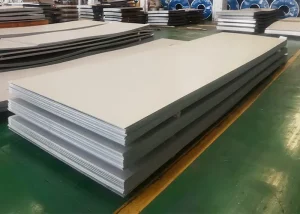
ASTM A516
- Home
- Products
- Carbon Steel Stocks
- ASTM A516
Basic Info
The ASTM A516 standard specifies the standard specifications for carbon steel plates for medium and low temperature pressure vessels. Commonly used in the manufacturing of storage tanks, boilers, and other pressure vessels. These steel plates have good weldability and mechanical properties, and have stable strength under medium and low temperature conditions. This standard covers the chemical composition, mechanical properties, and dimensional requirements of steel plates, ensuring that products meet engineering requirements and quality standards.
Characteristics
Pressure Vessel Grade: ASTM A516 steel is specifically designed for use in welded pressure vessels where improved notch toughness is important. It is suitable for moderate and lower temperature service.
Multiple Grades: The specification includes several grades (55, 60, 65, and 70), each offering different levels of tensile strength and toughness to meet specific application requirements.
Excellent Weldability: ASTM A516 steel exhibits excellent weldability, allowing for ease of fabrication and the creation of complex structures without sacrificing integrity or performance.
Notch Toughness: ASTM A516 steel is characterized by its notch toughness, which refers to its ability to resist brittle fracture under impact loading. This property is crucial for ensuring the integrity and safety of pressure vessels operating in demanding conditions.
Suitable for Various Applications: ASTM A516 steel is widely used in industries such as oil and gas, chemical processing, and power generation, where pressure vessels are required to store and transport liquids and gases under moderate to lower temperatures.
ASTM A516 Data Sheet
Steel Grade
Dimensions and Tolerances
Equivalent Steel Grades
Chemical Composition
Mechanical Properties
Fabrication and Welding
Steel Grade
Grade 55
- Tensile Strength (MPa): 380–515
- Yield Strength (MPa): 205 min
- Elongation (%): 27 min
- Charpy V-Notch Impact Test (Joule): 20 min at -30°C (ASTM A370)
Grade 60
- Tensile Strength (MPa): 415–550
- Yield Strength (MPa): 220 min
- Elongation (%): 25 min
- Charpy V-Notch Impact Test (Joule): 20 min at -30°C (ASTM A370)
Grade 65
- Tensile Strength (MPa): 450–585
- Yield Strength (MPa): 240 min
- Elongation (%): 23 min
- Charpy V-Notch Impact Test (Joule): 20 min at -30°C (ASTM A370)
Grade 70
- Tensile Strength (MPa): 485–620
- Yield Strength (MPa): 260 min
- Elongation (%): 21 min
- Charpy V-Notch Impact Test (Joule): 20 min at -30°C (ASTM A370)
Dimensions and Tolerances
Plate
- Width (mm): 600–2500
- Thickness (mm): 6–120
- Tolerance on Thickness (mm): ±0.10 (≤25)
- Tolerance on Width (mm): ±0.025 (≤1.59)
Sheet
- Width (mm): 600–2500
- Thickness (mm): 0.4–6.35
- Tolerance on Thickness (mm): ±0.10 (≤25)
- Tolerance on Width (mm): ±0.025 (≤1.59)
Strip
- Width (mm): 12.7–620
- Thickness (mm): 0.4–5.06
- Tolerance on Thickness (mm): ±0.10 (≤10)
- Tolerance on Width (mm): ±0.025 (≤1.59)
Equivalent Steel Grades
United Kingdom
- Equivalent Grade: BS 1501-224-490B
- Standard: BS 1501
- Notes: Pressure vessel steel grade
Germany
- Equivalent Grade: DIN 17155 17 Mn 4
- Standard: DIN 17155
- Notes: Pressure vessel steel grade
Japan
- Equivalent Grade: JIS G3115 SPV490
- Standard: JIS G3115
- Notes: Carbon steel plate for pressure vessels
China
- Equivalent Grade: GB 713 Q345R
- Standard: GB 713
- Notes: Pressure vessel steel grade
Chemical Composition
Grade 55:
- Carbon (C): 0.18 – 0.25
- Manganese (Mn): 0.50 – 0.90
- Phosphorus (P): 0.025 max
- Sulfur (S): 0.025 max
- Silicon (Si): 0.15 – 0.40
Grade 60:
- Carbon (C): 0.21 – 0.27
- Manganese (Mn): 0.85 – 1.20
- Phosphorus (P): 0.025 max
- Sulfur (S): 0.025 max
- Silicon (Si): 0.15 – 0.40
Grade 65:
- Carbon (C): 0.21 – 0.27
- Manganese (Mn): 0.85 – 1.20
- Phosphorus (P): 0.025 max
- Sulfur (S): 0.025 max
- Silicon (Si): 0.15 – 0.40
Grade 70:
- Carbon (C): 0.27 – 0.35
- Manganese (Mn): 0.85 – 1.20
- Phosphorus (P): 0.025 max
- Sulfur (S): 0.025 max
- Silicon (Si): 0.15 – 0.40
Mechanical Properties
Grade 55:
- Tensile Strength (MPa): 380 – 515
- Yield Strength (MPa): ≥ 255
- Elongation (%): ≥ 27
- Charpy V-notch Impact Test: 20 min at -20°C (ASTM A370)
Grade 60:
- Tensile Strength (MPa): 415 – 550
- Yield Strength (MPa): ≥ 220
- Elongation (%): ≥ 25
- Charpy V-notch Impact Test: 20 min at -20°C (ASTM A370)
Grade 65:
- Tensile Strength (MPa): 450 – 585
- Yield Strength (MPa): ≥ 240
- Elongation (%): ≥ 23
- Charpy V-notch Impact Test: 20 min at -20°C (ASTM A370)
Grade 70:
- Tensile Strength (MPa): 485 – 620
- Yield Strength (MPa): ≥ 260
- Elongation (%): ≥ 21
- Charpy V-notch Impact Test: 20 min at -20°C (ASTM A370)
Fabrication and Welding
Cutting:
Flame Cutting
- Guidelines: Use proper cutting tools and techniques
- Notes: Avoid excessive heat input and maintain cleanliness
Plasma Cutting
- Guidelines: Use appropriate cutting parameters and consumables
- Notes: Ensure proper ventilation and safety precautions
Shearing
- Guidelines: Ensure sharp blades and proper alignment
- Notes: Minimize edge distortion and burrs
Forming:
Hot Forming
- Guidelines: Follow recommended forming temperatures and methods
- Notes: Use suitable dies and lubricants for deformation
Cold Forming
- Guidelines: Preheat material as necessary for cold forming
- Notes: Use appropriate bending radius and avoid overstrain
Machining:
Drilling
- Guidelines: Use sharp drills and appropriate cutting speeds
- Notes: Provide adequate support and minimize vibration
Milling
- Guidelines: Select suitable tooling and cutting parameters
- Notes: Use coolant/lubricant for heat dissipation and chip removal
Turning
- Guidelines: Choose appropriate cutting tools and speeds
- Notes: Ensure proper fixturing and rigidity
Welding:
Arc Welding (SMAW, GMAW)
- Guidelines: Preheat and control interpass temperature
- Notes: Use low-hydrogen electrodes for SMAW and proper shielding gas for GMAW
Submerged Arc Welding
- Guidelines: Maintain proper flux coverage and travel speed
- Notes: Ensure clean and dry welding surfaces
Gas Tungsten Arc Welding (GTAW)
- Guidelines: Employ proper technique and shielding gas
- Notes: Use filler metal with suitable strength and ductility
Flux-Cored Arc Welding
- Guidelines: Select appropriate flux-cored wire and parameters
- Notes: Control travel speed and maintain proper arc length
Resistance Welding
- Guidelines: Ensure proper alignment and pressure during welding
- Notes: Minimize distortion and ensure adequate joint penetration
Comparisons and Alternatives of ASTM A516
Alternatives to ASTM A516:
ASTM A537: Offers higher tensile strength and improved impact resistance compared to ASTM A516, making it suitable for even more demanding pressure vessel applications.
ASTM A36/A572/A588: These structural steels offer good strength and corrosion resistance, although they may not possess the same level of notch toughness as ASTM A516.
API 5L Grade X70/X80: These high-strength low-alloy (HSLA) steels are commonly used in oil and gas pipelines and may offer advantages in specific applications requiring high strength and toughness.
Suitability for Specific Applications:
ASTM A516 steel is well-suited for pressure vessel fabrication in industries such as oil and gas, chemical processing, and power generation, where notch toughness and weldability are critical.
When considering alternatives, engineers must assess factors such as operating conditions, temperature ranges, corrosion resistance requirements, and cost considerations to determine the most suitable material for their specific application.

