
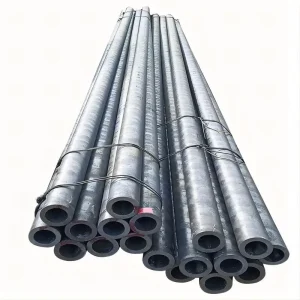
17-4PH Stainless Steel
- Home
- Products
- Stainless Steel Stocks
- 17-4PH Stainless Steel
Basic Info
17-4PH is a precipitation-hardening stainless steel with a composition of 17% chromium, 4% nickel, 4% copper, and 0.5% titanium. This alloy enhances mechanical properties through a two-stage process: solution treatment and aging treatment. In the solution treatment, the alloy is heated to a high temperature to dissolve all alloying elements, forming a solid solution. It is then cooled at a controlled rate to maintain this state. The aging treatment involves holding the alloy at a specific temperature for a set duration, allowing fine precipitates to form within the material. This process significantly increases hardness and strength.
Precipitation-hardened steels, including 17-4PH, are known for their high strength and hardness, making them suitable for demanding applications in industries like aerospace, nuclear, and marine engineering. The combination of strength, toughness, and corrosion resistance makes 17-4PH ideal for critical components that must perform under extreme conditions. Overall, 17-4PH is a versatile and reliable material for high-performance applications.
17-4PH Stainless Steel Data Sheet
Production Standards
Chemical Composition
Comparison Table
Production Standards
17-7PH
Nation: USA | Standard: AMS 5528 | Standard Name: Precipitation-hardened steel plate
Nation: Japan | Standard: JIS SUS 631 | Standard Name: Precipitation-hardened stainless steel
Nation: Germany | Standard: DIN 1.4568 | Standard Name: Precipitation-hardened stainless steel
Nation: China | Standard: GB/T 1220-2007 | Standard Name: Stainless steel rod
15-5PH
Nation: USA | Standard: AMS 5659 | Standard Name: Precipitation-hardened steel rod
Nation: Japan | Standard: JIS SUS 632 | Standard Name: Precipitation-hardened stainless steel
Nation: Germany | Standard: DIN 1.4545 | Standard Name: Precipitation-hardened stainless steel
Nation: China | Standard: GB/T 1220-2007 | Standard Name: Stainless steel rod
17-4PH
Nation: USA | Standard: AMS 5604 | Standard Name: Precipitation-hardened steel plate
Nation: Japan | Standard: JIS SUS 630 | Standard Name: Precipitation-hardened stainless steel
Nation: Germany | Standard: DIN 1.4542 | Standard Name: Precipitation-hardened stainless steel
Nation: China | Standard: GB/T 1220-2007 | Standard Name: Stainless steel rod
Chemical Composition
17-7PH
Ni (Nickel): 6.50 – 7.75%
Cr (Chromium): 16.00 – 18.00%
Al (Aluminum): 0.75 – 1.50%
C (Carbon): ≤ 0.09%
Mn (Manganese): ≤ 1.00%
Si (Silicon): ≤ 1.00%
P (Phosphorus): ≤ 0.040%
S (Sulfur): ≤ 0.030%
Cu (Copper): ≤ 0.50%
Fe (Iron): Remaining
15-5PH
Ni (Nickel): 3.50 – 5.50%
Cr (Chromium): 14.00 – 15.50%
Al (Aluminum): –
C (Carbon): ≤ 0.07%
Mn (Manganese): ≤ 1.00%
Si (Silicon): ≤ 1.00%
P (Phosphorus): ≤ 0.040%
S (Sulfur): ≤ 0.030%
Cu (Copper): 3.50 – 5.50%
Fe (Iron): Remaining
17-4PH
Ni (Nickel): 3.00 – 5.00%
Cr (Chromium): 15.00 – 17.50%
Al (Aluminum): –
C (Carbon): ≤ 0.07%
Mn (Manganese): ≤ 1.00%
Si (Silicon): ≤ 1.00%
P (Phosphorus): ≤ 0.040%
S (Sulfur): ≤ 0.030%
Cu (Copper): 3.00 – 5.00%
Fe (Iron): Remaining
Comparison Table
17-7PH
Aging Status: After aging treatment
Hardness (HRC): 30-42
Aging Status: After heat treatment
Hardness (HRC): 30-34
15-5PH
Aging Status: After aging treatment
Hardness (HRC): 33-44
Aging Status: After heat treatment
Hardness (HRC): 33-38
17-4PH
Aging Status: After aging treatment
Hardness (HRC): 28-42
Aging Status: After heat treatment
Hardness (HRC): 28-32
Common Heat Treatment Processes
Aging: heating the material to an appropriate temperature and then maintaining it for some time to promote the formation of precipitation-hardening phases and improve strength and hardness.
Solution Annealing: Heating the material to a high enough temperature to dissolve the alloy elements in the solid solution, and then cooling it rapidly to avoid precipitation of the hardening phase to improve the processability of the material.
Quenching: After solid solution treatment, the material is rapidly cooled to quickly fix the solid solution structure and increase hardness and strength.
Precipitation Hardening: Through aging treatment at appropriate temperatures, alloy elements are promoted to precipitate hardening phases, thereby increasing the strength and hardness of the material.
Double Aging Processes
Double-Aged 1050DH
Double-aged at a lower temperature, usually around 1050°F (approximately 565°C).
Double-Aged 900DH
Double-aged at a lower temperature, usually around 900°F (approximately 482°C).
Double Aged 800DH
Double aged at a lower temperature, usually around 800°F (approximately 427°C).
Applications
17-7PH
Most Common Applications: 17-7PH stainless steel is commonly used in the aerospace and aviation industries to manufacture parts, such as springs and connectors, due to its excellent strength and corrosion resistance.
Examples of rods: In the aerospace industry, 17-7PH rods are often used to manufacture high-performance springs and structural components, such as aircraft landing gear parts and fuselage connectors.
15-5PH
Most common applications: 15-5PH stainless steel is widely used to manufacture parts with high strength requirements, such as valves, pump bodies and drive shafts due to its excellent strength and corrosion resistance.
Examples of rods: In the manufacturing field, 15-5PH rods are often used to manufacture high-strength components such as valves, pump bodies, and transmission shafts to meet the corrosion resistance and wear resistance requirements of industrial equipment.
17-4PH
Most common applications: 17-4PH stainless steel is widely used to manufacture high-strength and corrosion-resistant parts such as marine equipment, chemical equipment, and medical equipment due to its excellent mechanical properties and corrosion resistance.
Examples of rods: In marine engineering, 17-4PH rods are often used to manufacture parts that work under seawater, such as connectors and protective equipment on offshore platforms, as well as components of subsea pipelines and deepwater drilling equipment.
