ASTM B443
- Home
- Products
- Alloy Steel Stocks
- ASTM B443
ASTM B443 Basic Info
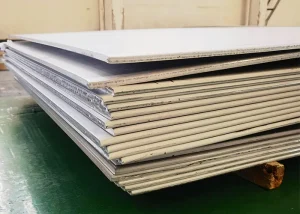
ASTM B443, a standard by ASTM International, defines the specifications for nickel-chromium-molybdenum-columbium alloys in plate, sheet, and strip forms. It covers key aspects like chemical composition, mechanical properties, and dimensional tolerances, ensuring reliability and uniformity in these materials. Applied across aerospace, chemical processing, and marine engineering sectors, ASTM B443 establishes the benchmark for manufacturing and performance of these corrosion-resistant alloys.
Characteristics of ASTM B443
- Oxidation Resistance: ASTM B443 materials are designed to resist oxidation, even at high temperatures. This property is crucial in applications where exposure to oxygen-rich environments, such as combustion chambers, is common.
- Versatility: The specification covers a range of nickel-chromium-molybdenum-columbium and nickel-chromium-molybdenum-silicon alloys, providing options for various applications. This versatility allows engineers to select the most suitable material based on specific requirements.
- Quality Assurance: ASTM B443 provides detailed guidelines for the chemical composition, mechanical properties, and manufacturing processes of these materials. This ensures consistent quality and performance, giving confidence to manufacturers and end-users alike.
- Weldability: Many ASTM B443 alloys exhibit good weldability, allowing for ease of fabrication and joining processes. This is important for industries where welding is a common method of construction, such as the aerospace and petrochemical sectors.
ASTM B443 Data Sheet
Steel Grade
Dimensions and Tol.
Equivalent Steel Grades
Chemical Composition
Mechanical Properties
Fabrication and Welding
Steel Grade
ASTM B443 UNS N06225:
Nickel-Chromium-Molybdenum-Columbium Alloy (Inconel 625)
ASTM B446 UNS N10276:
Nickel-Chromium-Molybdenum-Silicon Alloy (Inconel C276)
Dimensions and Tol.
Sheet:
Width: 48 inches max
Thickness: 0.0015 to 0.187 inches
Tolerances:
Width: ±0.010 inches (±0.25 mm)
Thickness: ±10% or ±0.005 inches (±0.13 mm), whichever is greater
Strip:
Width: 48 inches max
Thickness: 0.0015 to 0.025 inches
Tolerances:
Width: ±0.010 inches (±0.25 mm)
Thickness: ±10% or ±0.005 inches (±0.13 mm), whichever is greater
Plate:
Width: 96 inches max
Thickness: 0.1875 to 4.000 inches
Tolerances:
Width: ±0.250 inches (±6.35 mm)
Thickness: ±10% or ±0.0625 inches (±1.58 mm), whichever is greater
Equivalent Steel Grades
Germany: DIN 2.4627 (NiCr22Mo9Nb)
Japan: 15 NiCr 22 (SUS G21/G25)
China: GB/T N0128 (G21/G25)
UK: BS Ni 21 (Inconel G25)
Chemical Composition
UNS N06225 (Inconel G25):
Carbon (C): 0.015% max
Manganese (Mn): 0.50% max
Phosphorus (P): 0.015% max
Sulfur (S): 0.015% max
Silicon (Si): 0.50% max
Chromium (Cr): 20.0–23.0%
Nickel (Ni): Balance
Molybdenum (Mo): 8.0–10.0%
Iron (Fe): 5.0–10.0%
Titanium (Ti): 0.40% max
UNS N06219 (Inconel G22):
Carbon (C): 0.025% max
Manganese (Mn): 0.50% max
Phosphorus (P): 0.020% max
Sulfur (S): 0.015% max
Silicon (Si): 0.50% max
Chromium (Cr): 20.0–24.0%
Nickel (Ni): 60.0–65.0%
Molybdenum (Mo): 2.0–3.0%
Iron (Fe): 5.0–7.0%
Titanium (Ti): 1.0–2.0%
Aluminum (Al): 0.30% max
Cobalt (Co): 0.50–1.0%
Tantalum (Ta): 1.5–2.0%
Mechanical Properties
UNS N06225 (Inconel G25), Annealed:
Tensile Strength, min: 120 ksi (827 MPa)
Yield Strength (0.2% offset), min: 63 ksi (434 MPa)
Elongation in 2 inches (50.8 mm) or 4D, min: 30%
Reduction of Area, min: 30%
Hardness, max (HRB): 100
Hardness, max (HRC): 32
UNS N06219 (Inconel G22), Annealed:
Tensile Strength, min: 120 ksi (827 MPa)
Yield Strength (0.2% offset), min: 48 ksi (331 MPa)
Elongation in 2 inches (50.8 mm) or 4D, min: 40%
Reduction of Area, min: 40%
Hardness, max (HRB): 95
Hardness, max (HRC): 30
Fabrication and Welding
Hot Working:
Recommendations for UNS N06225 (Inconel G25):
- Hot work at temperatures between 1700°F (927°C) and 2150°F (1177°C).
- Use uniform reduction and avoid excessive reheating.
Recommendations for UNS N06219 (Inconel G22):
- Hot work at temperatures between 1800°F (982°C) and 2150°F (1177°C).
- Use uniform reduction and avoid excessive reheating.
Cold Working:
Recommendations for UNS N06225 (Inconel G25):
- Suitable for cold working using standard methods.
- Cold working may result in increased strength.
Recommendations for UNS N06219 (Inconel G22):
- Suitable for cold working using standard methods.
- Cold working may result in increased strength and reduced ductility.
Annealing:
Recommendations for UNS N06225 (Inconel G25):
- Anneal at 1700-1925°F (927-1052°C) for 1 hour per inch of thickness.
- Furnace cool at a rate not exceeding 100°F (56°C) per hour.
Recommendations for UNS N06219 (Inconel G22):
- Anneal at 1925-2050°F (1052-1121°C) for 1 hour per inch of thickness.
- Furnace cool at a rate not exceeding 100°F (56°C) per hour.
Weldability:
Recommendations for UNS N06225 (Inconel G25):
- Weld using common techniques such as TIG, MIG, and SMAW.
- Use filler metals of the same alloy, such as AWS A5.14 ERNiCrMo-3.
- Preheat and post-weld heat treatment may be necessary for thick sections.
Recommendations for UNS N06219 (Inconel G22):
- Weld using common techniques such as TIG, MIG, and SMAW.
- Use filler metals of the same alloy, such as AWS A5.14 ERNiCrMo-10.
- Preheat and post-weld heat treatment may be necessary for thick sections.
The Rigorous Testing of Inconel 625 for Critical Applications
Inconel 625 undergoes meticulous testing procedures to ensure it meets stringent specifications for its intended applications. These rigorous tests are vital to guarantee its exceptional performance and reliability in demanding environments.
Testing includes thorough checks for chemical composition to ensure precise levels of elements like nickel, chromium, and molybdenum. Mechanical properties such as tensile strength, yield strength, and elongation are carefully measured to ensure they meet or exceed the required standards outlined in ASTM B443.
Additionally, corrosion resistance tests are conducted to simulate harsh operating conditions, ensuring the alloy’s ability to withstand corrosive environments without degradation. Heat treatment tests verify the material’s response to various thermal conditions, critical for applications in high-temperature environments.
Non-destructive testing methods like ultrasonic testing and radiography are employed to detect any internal defects or irregularities. These comprehensive tests, coupled with adherence to ASTM B443 standards, provide customers with the assurance that Inconel 625 is reliable, durable, and capable of meeting the demanding requirements of aerospace, chemical processing, marine engineering, and other industries.