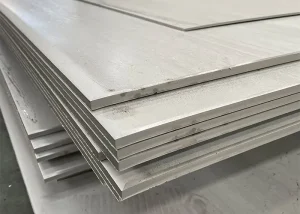

ASTM B409
- Home
- Products
- Alloy Steel Stocks
- ASTM B409
ASTM B409 Basic Info
Our product adheres to the ASTM B409 standard, ensuring the highest quality nickel-iron-chromium alloy plate, sheet, or strip. Compliant with rigorous industry specifications, ASTM B409 certification underscores our commitment to delivering materials that meet stringent mechanical and dimensional requirements. By adhering to ASTM B409 standards, we assure customers of superior performance and durability in corrosive environments.
Characteristics of ASTM B409
- Good Mechanical Properties: ASTM B409 alloys typically have good mechanical properties, including strength and ductility. This makes them useful for various structural applications.
- Ease of Fabrication: Nickel-iron-chromium alloys can often be easily fabricated and formed into different shapes, which is beneficial for manufacturing processes.
- Weldability: ASTM B409 steel generally has good weldability, allowing for the joining of pieces during fabrication without significant issues.
- Magnetic Properties: Depending on the specific alloy composition, ASTM B409 steel can exhibit magnetic properties, which may be desirable for certain applications.
ASTM B409 Data Sheet
Steel Grade
Dimensions and Tolerances
Equivalent Steel Grades
Chemical Composition
Mechanical Properties
Fabrication and Welding
Steel Grade
Grade N08800
Grade N08810
Grade N08811
Grade N08825
Grade N08120
Grade N08890
Dimensions and Tolerances
Sheet:
- Thickness Range: 0.1875 to 2.000 inches
- Width Range: 24 to 48 inches
- Tolerance for Thickness: ±0.010 inches
- Tolerance for Width: ±0.125 inches
Strip:
- Thickness Range: 0.1875 to 2.000 inches
- Width Range: 0.500 to 24 inches
- Tolerance for Thickness: ±0.010 inches
- Tolerance for Width: ±0.062 inches
Plate:
- Thickness Range: 0.1875 to 2.000 inches
- Width Range: 24 to 48 inches
- Tolerance for Thickness: ±0.010 inches
- Tolerance for Width: ±0.125 inches
Coil:
- Thickness Range: 0.1875 to 2.000 inches
- Width Range: 24 to 48 inches
- Tolerance for Thickness: ±0.010 inches
- Tolerance for Width: ±0.125 inches
Other Forms:
- Thickness Range: Varies
- Width Range: Varies
- Tolerance for Thickness: Varies
- Tolerance for Width: Varies
Equivalent Steel Grades
N08800:
- Germany (DIN): 1.4876
- Japan (JIS): NCF800
- France (AFNOR): Z8NC32-21
- United Kingdom (BS): NA15
N08810:
- Germany (DIN): 1.4876
- Japan (JIS): NCF800
- France (AFNOR): Z8NC32-21
- United Kingdom (BS): NA15
N08811:
- Germany (DIN): 1.4876
- Japan (JIS): NCF800
- France (AFNOR): Z8NC32-21
- United Kingdom (BS): NA15
N08825:
- Germany (DIN): 2.4858
- Japan (JIS): NCF825
- France (AFNOR): Z6NC32-21
- United Kingdom (BS): NA16
N08120:
- Germany (DIN): 1.4959
- Japan (JIS): NCF820
- France (AFNOR): Z12NCDU25-20
- United Kingdom (BS): NA17
N08890:
- Germany (DIN): 1.4959
- Japan (JIS): NCF820
- France (AFNOR): Z12NCDU25-20
- United Kingdom (BS): NA17
Chemical Composition
N08800:
- Nickel (Ni): 30.0–35.0%
- Chromium (Cr): 19.0–23.0%
- Iron (Fe): 39.5% min
- Copper (Cu): 0.75% max
- Manganese (Mn): 1.5% max
- Carbon (C): 0.10% max
- Silicon (Si): 1.0% max
- Sulfur (S): 0.015% max
- Aluminum (Al): 0.15–0.60%
- Titanium (Ti): 0.15–0.60%
N08810:
- Nickel (Ni): 30.0–35.0%
- Chromium (Cr): 19.0–23.0%
- Iron (Fe): 39.5% min
- Copper (Cu): 0.75% max
- Manganese (Mn): 1.5% max
- Carbon (C): 0.05–0.10%
- Silicon (Si): 1.0% max
- Sulfur (S): 0.015% max
- Aluminum (Al): 0.15–0.60%
- Titanium (Ti): 0.15–0.60%
N08811:
- Nickel (Ni): 30.0–35.0%
- Chromium (Cr): 19.0–23.0%
- Iron (Fe): 39.5% min
- Copper (Cu): 0.75% max
- Manganese (Mn): 1.5% max
- Carbon (C): 0.06–0.10%
- Silicon (Si): 1.0% max
- Sulfur (S): 0.015% max
- Aluminum (Al): 0.25–0.60%
- Titanium (Ti): 0.25–0.60%
N08825:
- Nickel (Ni): 38.0–46.0%
- Chromium (Cr): 19.5–23.5%
- Iron (Fe): 22.0% min
- Copper (Cu): 1.5–3.0%
- Manganese (Mn): 1.0% max
- Carbon (C): 0.05% max
- Silicon (Si): 0.5% max
- Sulfur (S): 0.03% max
- Aluminum (Al): 0.20% max
- Titanium (Ti): 0.6–1.2%
N08120:
- Nickel (Ni): 45.0–55.0%
- Chromium (Cr): 14.0–16.0%
- Iron (Fe): 22.0–26.0%
- Copper (Cu): 0.75% max
- Manganese (Mn): 1.0% max
- Carbon (C): 0.05% max
- Silicon (Si): 0.75% max
- Sulfur (S): 0.015% max
- Aluminum (Al): 0.50–0.70%
N08890:
- Nickel (Ni): 42.0–46.0%
- Chromium (Cr): 13.0–15.0%
- Iron (Fe): 0.50% max
- Copper (Cu): 0.75% max
- Manganese (Mn): 1.0% max
- Carbon (C): 0.05% max
- Silicon (Si): 0.75% max
- Sulfur (S): 0.015% max
- Aluminum (Al): 0.015% max
- Cobalt (Co): 2.00–3.00%
Mechanical Properties
N08800 (Alloy 800):
- Tensile Strength: 75–100 ksi (520–690 MPa)
- Yield Strength, 0.2% offset: 30–50 ksi (205–345 MPa)
- Elongation in 2 inches: 30% min
- Hardness (HRB): 90 max
- Hardness (HB): 180
- Hardness (HV): 180
- Density: 7.94 g/cm³
- Electrical Resistivity: 1.08 (Ω·m)
N08810 (Alloy 800H):
- Tensile Strength: 75–100 ksi (520–690 MPa)
- Yield Strength, 0.2% offset: 30–50 ksi (205–345 MPa)
- Elongation in 2 inches: 30% min
- Hardness (HRB): 90 max
- Hardness (HB): 180
- Hardness (HV): 180
- Density: 7.94 g/cm³
- Electrical Resistivity: 1.08 (Ω·m)
N08811 (Alloy 800HT):
- Tensile Strength: 75–100 ksi (520–690 MPa)
- Yield Strength, 0.2% offset: 30–50 ksi (205–345 MPa)
- Elongation in 2 inches: 30% min
- Hardness (HRB): 90 max
- Hardness (HB): 180
- Hardness (HV): 180
- Density: 7.94 g/cm³
- Electrical Resistivity: 1.08 (Ω·m)
N08825 (Alloy 825):
- Tensile Strength: 80–105 ksi (550–725 MPa)
- Yield Strength, 0.2% offset: 30–40 ksi (205–275 MPa)
- Elongation in 2 inches: 30% min
- Hardness (HRB): 85 max
- Hardness (HB): 163
- Hardness (HV): 163
- Density: 8.14 g/cm³
- Electrical Resistivity: 1.13 (Ω·m)
N08120 (Alloy 120):
- Tensile Strength: 110 ksi (760 MPa)
- Yield Strength, 0.2% offset: 65 ksi (450 MPa)
- Elongation in 2 inches: 20% min
- Hardness (HRB): 75 max
- Hardness (HB): 127
- Hardness (HV): 127
- Density: 8.44 g/cm³
N08890 (Alloy 90):
- Tensile Strength: 90 ksi (620 MPa)
- Yield Strength, 0.2% offset: 25 ksi (170 MPa)
- Elongation in 2 inches: 25% min
- Hardness (HRB): 85 max
- Hardness (HB): 163
- Hardness (HV): 163
- Density: 8.19 g/cm³
Fabrication and Welding
- Forming: These alloys are generally easy to form using processes such as bending, drawing, and deep drawing. Cold forming and hot forming are both suitable. Use proper lubricants and tooling to minimize tool wear and achieve desired shapes without cracking.
- Machining: Conventional machining techniques can be used, such as turning, milling, drilling, and tapping. Use sharp tools with proper geometry to minimize work hardening. Provide adequate cooling and lubrication to prevent workpiece overheating and tool wear.
- Welding: Suitable welding methods include gas tungsten arc welding (GTAW/TIG), gas metal arc welding (GMAW/MIG), shielded metal arc welding (SMAW), and submerged arc welding (SAW). Use matching filler metals such as ERNiCr-3 (AWS A5.14) or ENiCrFe-3 (AWS A5.11).
- Preheating: Preheat as required based on the specific alloy and thickness. Generally, preheating is recommended for thicker sections to prevent cracking and improve weld quality. Follow manufacturer’s recommendations and welding procedure specifications (WPS).
- Post-Weld Heat Treat: Post-weld heat treatment may be necessary depending on the alloy and welding conditions. Annealing after welding can restore corrosion resistance. Follow proper procedures for controlled cooling to prevent distortion and stress.
- Inspection: Perform visual inspection to check for weld quality, surface cleanliness, and proper joint preparation. Use non-destructive testing (NDT) methods such as liquid penetrant testing (PT), magnetic particle testing (MT), or ultrasonic testing (UT) as needed.
How does the ASTM409 cost compare to other materials?
The cost of ASTM B409 nickel-iron-chromium alloys can vary based on several factors including the specific grade, market demand, raw material costs, production processes, and supplier pricing. Here are some general considerations when comparing the cost of ASTM B409 alloys to other materials:
Material Grade: Different grades of ASTM B409 alloys can have varying costs. Higher nickel content generally leads to higher material costs.
Alloy Complexity: Some ASTM B409 alloys may contain additional elements like molybdenum, copper, or titanium, which can affect the cost.
Market Demand: The demand for nickel-based alloys, including ASTM B409 materials, can impact pricing. Fluctuations in demand due to market conditions, global events, or industry trends can influence costs.
Production Volume: Larger production volumes can sometimes lead to economies of scale, reducing the cost per unit. Conversely, smaller production runs may result in higher costs.
Manufacturing Processes: The complexity of manufacturing processes, such as melting, casting, rolling, and finishing, can impact the cost of the final product.
Supplier Pricing: Different suppliers may offer ASTM B409 alloys at different price points. Factors such as supplier reputation, location, and inventory levels can influence pricing.
Competition: Competition among suppliers and manufacturers can also affect pricing. More competition can sometimes lead to lower prices for customers.
When comparing the cost of ASTM B409 alloys to other materials, it’s essential to consider the specific requirements of the application. While ASTM B409 alloys may have a higher upfront cost compared to some standard steels or alloys, they often provide superior corrosion resistance, high-temperature performance, and other desirable properties. This can result in long-term savings by reducing maintenance, replacement, and downtime costs.
Customers should also consider the total cost of ownership, which includes factors beyond the initial material cost. This includes factors like installation costs, maintenance requirements, lifecycle durability, and potential cost savings from improved performance.
To get an accurate cost comparison, customers should reach out to multiple suppliers, request quotes based on their specific requirements, and consider the overall value and benefits offered by ASTM B409 alloys compared to alternative materials.