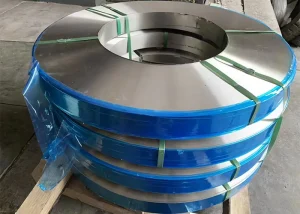

ASTM A1008M
- Home
- Products
- Stainless Steel Stocks
- ASTM A1008M
Basic Info
The ASTM A1008M standard specifies general requirements for cold-rolled non oriented electrical steel plates, strips, and sheets. This standard applies to low-carbon steel sheets required for the manufacture of motors, transformers, coils, and other electrical equipment. The A1008M standard covers the chemical composition, mechanical properties, dimensions, and surface quality requirements of steel plates to ensure that product quality meets the standards and meets the requirements of electrical equipment manufacturing.
Characteristics
Cold-Rolled Structural Steel: ASTM A1008M specifies cold-rolled steel sheet in coils and cut lengths for structural applications. It is suitable for forming, bending, and fabrication processes commonly used in construction and manufacturing.
High-Strength Low-Alloy (HSLA): ASTM A1008M includes high-strength low-alloy steel grades, which offer improved strength and durability compared to conventional carbon steel grades while maintaining good formability.
Improved Formability: This specification covers steel grades with improved formability, making them suitable for complex shapes and deep drawing applications. The steel can be easily formed into various shapes without sacrificing mechanical properties.
Wide Range of Thickness and Width: ASTM A1008M steel is available in various thicknesses, starting from 0.015 inches (0.38 mm), and widths of 48 inches (1,219 mm) or more, providing flexibility for different manufacturing requirements.
Versatile Applications: ASTM A1008M steel is commonly used in a wide range of applications, including construction, automotive manufacturing, appliances, furniture, and other structural components where strength, formability, and weldability are essential.
Consistent Quality Assurance: Compliance with ASTM A1008M ensures consistent quality and performance of the steel products, meeting rigorous standards for chemical composition, mechanical properties, surface finish, dimensions, and tolerances. This helps manufacturers produce reliable and durable products that meet industry requirements and customer expectations.
ASTM A1008M Data Sheet
Steel Grade
Dimensions and Tolerances
Equivalent Grades
Chemical Composition
Mechanical Properties
Fabrication and Welding
Steel Grade
Commercial Steel (CS)
Example Grades: CS Type A, CS Type B, CS Type C
Drawing Quality Steel (DQ)
Example Grades: DQ Type A, DQ Type B
Structural Steel (SS)
Example Grades: SS Grade 25, SS Grade 30, SS Grade 33
High-Strength Low-Alloy (HSLA) Steel
Example Grades: HSLA Grade 30, HSLA Grade 40, HSLA Grade 50
High-Strength Low-Alloy with Improved Formability (HSLA-F) Steel
Example Grades: HSLA-F Grade 50, HSLA-F Grade 60, HSLA-F Grade 70
Dimensions and Tolerances
Shape
Sheet, Coil
Width
Up to 60 inches (1524 mm)
Thickness
0.015 inches (0.38 mm) and thicker
Tolerances
Thickness: ±0.001 inches (0.025 mm)
Width: ±0.032 inches (0.8 mm) for all widths
Flatness: Within ASTM A568/A568M requirements
Camber: Maximum 0.015 inches (0.38 mm) per foot
Equivalent Grades
United States
AISI/SAE designation (e.g., AISI 1008, AISI 1010, AISI 1020)
United Kingdom
BS (British Standard) designation (e.g., BS 1449 CR4)
Japan
JIS (Japanese Industrial Standards) designation (e.g., JIS SPCC, JIS SPCD)
European Union
EN (European Norm) designation (e.g., EN DC01, EN DC04)
Chemical Composition
Carbon (C)
0.02 – 0.15%
Manganese (Mn)
0.30 – 1.50%
Phosphorus (P)
0.04% max
Sulfur (S)
0.05% max
Silicon (Si)
0.02 – 0.50%
Mechanical Properties
Tensile Strength
280 – 450 MPa
Yield Strength
170 – 330 MPa
Elongation
20% – 40%
Hardness (Rockwell B)
40 – 70 HRB
Fabrication and Welding
Forming
Cold-rolled steel is suitable for bending and forming, but it tends to spring back more than hot-rolled steel.
Use press brakes with sharp tooling and proper bending radii to achieve accurate bends. Annealing or stress relieving may be necessary after forming to restore material properties.
Machining
When machining cold-rolled steel, use sharp tools and low cutting speeds to minimize work hardening and tool wear.
Cooling lubricants or cutting fluids may be required, especially for drilling and milling operations.
Welding
Use welding methods such as Shielded Metal Arc Welding (SMAW), Gas Metal Arc Welding (GMAW), or Gas Tungsten Arc Welding (GTAW) with appropriate electrodes and filler metals.
Preheat and post-heat as needed to prevent cracking, particularly for thicker sections. Control heat input to avoid distortion and maintain mechanical properties.
Ensure proper fit-up and joint preparation to achieve full penetration and minimize distortion. Implement back purging with inert gas for critical applications to ensure sound welds.
Post-Weld Heat Treatment
Heat treat as needed to relieve residual stresses and restore material properties. Follow recommended temperature and time cycles to avoid excessive grain growth or distortion.
Surface Finishing
After fabrication or welding, remove any burrs, scale, or sharp edges to achieve the desired surface finish.
Pickling and passivation treatments may be required to remove surface oxides and restore corrosion resistance.
Inspection and Testing
Inspect welds for defects such as cracks, porosity, and incomplete fusion. Perform dye penetrant or radiographic testing for critical applications.
Follow ASTM and industry standards for inspection and testing procedures to ensure the quality of fabricated components.
Comparison with Other Stainless Steel Standards
Grade Equivalences: Users may search for equivalent grades between ASTM A1008M and other standards, such as AISI/SAE, EN, and JIS, to find materials that meet their specific requirements and specifications.
Chemical Composition Comparisons: People may seek comparisons of the chemical compositions specified in ASTM A1008M with those in other standards to understand similarities and differences in alloying elements and their percentages.
Mechanical Property Equivalences: Users may look for equivalences in mechanical properties, such as tensile strength, yield strength, elongation, and hardness, between ASTM A1008M materials and those specified in other standards to ensure consistent performance across different materials.
Cross-Referencing and Conversion Tables: Individuals may search for cross-referencing tables or conversion charts that provide easy comparisons between ASTM A1008M materials and equivalent grades in other standards, facilitating material selection and substitution.
Global Acceptance and Compliance: People may seek information on the global acceptance and compliance of ASTM A1008M materials compared to other standards, such as EN and JIS, to assess their suitability for international markets and applications.
Industry Standards and Specifications: Users may look for information on industry-specific standards and specifications that reference ASTM A1008M materials and their equivalents in other standards, ensuring compliance with regulatory requirements and industry best practices.