ASTM A167
- Home
- Products
- Stainless Steel Stocks
- ASTM A167
Basic Info
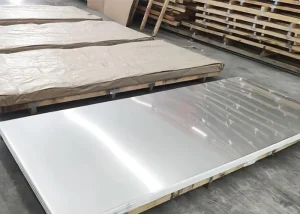
The ASTM A167 standard specifies the manufacturing requirements for stainless steel and high-temperature alloy plates, strips, and sheets. These materials are commonly used in fields such as chemical, aerospace, and food processing. The A167 standard covers chemical composition, mechanical properties, and dimensional requirements to ensure that product quality meets the standards and can meet various engineering requirements.
Characteristics
Corrosion Resistance: ASTM A167 steel exhibits excellent resistance to corrosion, particularly in acidic and corrosive environments, making it suitable for applications in chemical processing, food processing, and marine industries.
High Temperature Strength: This steel grade maintains its mechanical properties at elevated temperatures, making it suitable for use in high-temperature applications such as furnace components and heat exchangers.
Weldability: It possesses good weldability, enabling it to be welded using common welding methods without compromising its corrosion resistance or mechanical properties.
Strength and Durability: With its chromium and nickel content, ASTM A167 steel exhibits high strength and durability, ensuring long-term performance and reliability in demanding environments.
ASTM A167 Data Sheet
Steel Grade
Dimensions and Tolerances
Equivalent Grades
Chemical Composition
Mechanical Properties
Fabrication and Welding
Steel Grade
301
Chromium-nickel stainless steel, excellent corrosion resistance, and high strength. Commonly used in applications requiring good formability and moderate tensile strength.
304
Austenitic stainless steel, versatile and widely used for its excellent corrosion resistance, formability, and weldability. Suitable for a wide range of applications, including food processing, chemical processing, and architectural components.
316
Molybdenum-bearing austenitic stainless steel, offering enhanced corrosion resistance, particularly in chloride environments. Commonly used in marine applications, chemical processing, and pharmaceutical equipment.
430
Ferritic stainless steel, known for its good corrosion resistance in mildly corrosive environments and high-temperature oxidation resistance. Often used in automotive trim, appliances, and decorative applications.
Dimensions and Tolerances
301
Thickness: 0.1 mm (0.004 inches) to 6.0 mm (0.236 inches)
Width: Up to 1524 mm (60 inches)
Length: Custom or coil form
Tolerances:
Thickness as per ASTM A480/A480M standard
Width as per ASTM A480/A480M standard
Length as per customer requirements or ASTM A480/A480M standard
Surface Finish: Bright annealed, mill finish, or as specified by the customer
304
Thickness: 0.1 mm (0.004 inches) to 6.0 mm (0.236 inches)
Width: Up to 1524 mm (60 inches)
Length: Custom or coil form
Tolerances:
Thickness as per ASTM A480/A480M standard
Width as per ASTM A480/A480M standard
Length as per customer requirements or ASTM A480/A480M standard
Surface Finish: Bright annealed, mill finish, or as specified by the customer
316
Thickness: 0.1 mm (0.004 inches) to 6.0 mm (0.236 inches)
Width: Up to 1524 mm (60 inches)
Length: Custom or coil form
Tolerances:
Thickness as per ASTM A480/A480M standard
Width as per ASTM A480/A480M standard
Length as per customer requirements or ASTM A480/A480M standard
Surface Finish: Bright annealed, mill finish, or as specified by the customer
430
Thickness: 0.1 mm (0.004 inches) to 6.0 mm (0.236 inches)
Width: Up to 1524 mm (60 inches)
Length: Custom or coil form
Tolerances:
Thickness as per ASTM A480/A480M standard
Width as per ASTM A480/A480M standard
Length as per customer requirements or ASTM A480/A480M standard
Surface Finish: Bright annealed, mill finish, or as specified by the customer
Equivalent Grades
United States
Equivalent Grades: AISI 301, 304, 316, 430
Standard: AISI/SAE
Notes: AISI/SAE standards are commonly used in North America
United Kingdom
Equivalent Grades: 1.4310, 1.4301, 1.4401, 1.4016
Standard: BS EN (European Standards)
Notes: BS EN standards are widely adopted in the UK and Europe
Japan
Equivalent Grades: SUS301, SUS304, SUS316, SUS430
Standard: JIS (Japanese Industrial Standards)
Notes: JIS standards are commonly used in Japan and Asia
China
Equivalent Grades: 1Cr17Ni7, 0Cr18Ni9, 0Cr17Ni12Mo2, 1Cr17
Standard: GB/T (Chinese National Standards)
Notes: GB/T standards are prevalent in China and Asia
Chemical Composition
301
Carbon (C): 0.15 max
Manganese (Mn): 2.00 max
Phosphorus (P): 0.045 max
Sulfur (S): 0.030 max
Silicon (Si): 1.00 max
Chromium (Cr): 16.00–18.00
Nickel (Ni): 6.00–8.00
Nitrogen (N): –
Copper (Cu): –
Molybdenum (Mo): –
Iron (Fe): Balance
304
Carbon (C): 0.08 max
Manganese (Mn): 2.00 max
Phosphorus (P): 0.045 max
Sulfur (S): 0.030 max
Silicon (Si): 1.00 max
Chromium (Cr): 18.00–20.00
Nickel (Ni): 8.00–10.50
Nitrogen (N): –
Copper (Cu): –
Molybdenum (Mo): –
Iron (Fe): Balance
316
Carbon (C): 0.08 max
Manganese (Mn): 2.00 max
Phosphorus (P): 0.045 max
Sulfur (S): 0.030 max
Silicon (Si): 1.00 max
Chromium (Cr): 16.00–18.00
Nickel (Ni): 10.00–14.00
Nitrogen (N): –
Copper (Cu): –
Molybdenum (Mo): 2.00–3.00
Iron (Fe): Balance
430
Carbon (C): 0.12 max
Manganese (Mn): 1.00 max
Phosphorus (P): 0.040 max
Sulfur (S): 0.030 max
Silicon (Si): 1.00 max
Chromium (Cr): 16.00–18.00
Nickel (Ni): –
Nitrogen (N): –
Copper (Cu): –
Molybdenum (Mo): –
Iron (Fe): Balance
Mechanical Properties
301
Yield Strength: ≥ 205 MPa (≥ 30 ksi)
Tensile Strength: ≥ 515 MPa (≥ 75 ksi)
Elongation: ≥ 40%
Hardness (Rockwell B): ≤ 92
304
Yield Strength: ≥ 205 MPa (≥ 30 ksi)
Tensile Strength: ≥ 515 MPa (≥ 75 ksi)
Elongation: ≥ 40%
Hardness (Rockwell B): ≤ 92
316
Yield Strength: ≥ 205 MPa (≥ 30 ksi)
Tensile Strength: ≥ 515 MPa (≥ 75 ksi)
Elongation: ≥ 40%
Hardness (Rockwell B): ≤ 95
430
Yield Strength: ≥ 205 MPa (≥ 30 ksi)
Tensile Strength: ≥ 450 MPa (≥ 65 ksi)
Elongation: ≥ 22% (≥ 50 mm)
Hardness (Rockwell B): ≤ 89
Fabrication and Welding
Fabrication – Cutting
Method: Use methods such as shearing, sawing, or laser cutting for plates, sheet, and strip materials.
Guidelines: For thinner sections, consider abrasive cutting techniques. Ensure clean, sharp cutting tools to minimize distortion and achieve precise dimensions.
Notes: Lubricate cutting tools and maintain proper coolant to prevent work hardening and tool wear.
Fabrication – Forming
Method: Cold forming is preferred for most applications to avoid thermal distortion and work hardening.
Guidelines: Bend radius should be generous to prevent cracking. Typically 1.5 to 2 times the material thickness. Use appropriate lubricants to reduce friction and avoid galling.
Notes: Annealing may be required after forming to relieve stress.
Fabrication – Machining
Method: Carbide tooling is recommended for machining operations due to the work hardening tendency of stainless steels.
Guidelines: Use low cutting speeds and high feed rates to reduce heat generation and prolong tool life. Employ coolant where appropriate to prevent thermal distortion.
Notes: Perform machining operations in multiple passes to avoid excessive strain and maintain accuracy.
Welding – Shielded Metal Arc Welding (SMAW)
Method: Use low hydrogen electrodes (E308, E309) for austenitic grades and ferritic electrodes (E430) for ferritic grades.
Guidelines: Post-weld heat treatment and heavy interpass cleaning may be necessary. Apply appropriate welding techniques to ensure full penetration and fusion.
Notes: Perform post-weld cleaning to remove surface contamination for optimal corrosion resistance.
Welding – Gas Metal Arc Welding (GMAW)
Method: Utilize inert gas shielding (typically argon or argon/helium mixes) for the best results.
Guidelines: Adjust welding parameters to achieve proper penetration and minimize distortion.
Notes: Clean weld area thoroughly before welding to prevent contamination and ensure weld quality.
Welding – Gas Tungsten Arc Welding (GTAW)
Method: Employ high-purity argon shielding gas for best results. Use filler metals matching the base material (ER308, ER309) for austenitic grades.
Guidelines: Adjust welding parameters to control heat input and avoid overheating the material.
Notes: Back-purging may be necessary for critical applications to prevent oxidation of the weld root.
Welding – Flux-Cored Arc Welding (FCAW)
Method: Select flux-cored electrodes suitable for stainless steel (e.g., E308LT-1, E309LT-1).
Guidelines: Apply interpass cleaning and proper shielding gas (typically CO2 or argon/CO2 mixes) for best results.
Notes: Conduct post-weld cleaning to maintain the surface finish and integrity of welded joints.
Applications
Construction Industry: ASTM A167 materials, particularly stainless steel grades like Type 304 and Type 316, are widely utilized in the construction industry for various structural and architectural applications. These materials are favored for their excellent corrosion resistance, durability, and aesthetic appeal. Common applications include building facades, handrails, structural components, and decorative elements in commercial and residential buildings.
Automotive Sector: ASTM A167 stainless steel finds numerous applications in the automotive sector due to its high strength, corrosion resistance, and formability. It is commonly used for manufacturing automotive exhaust systems, trim components, fuel tanks, and structural reinforcements. The superior corrosion resistance of stainless steel helps enhance the longevity and performance of automotive parts, particularly in challenging environments exposed to road salts, moisture, and chemicals.
Industrial Equipment Manufacturing: ASTM A167 materials play a crucial role in the manufacturing of various industrial equipment and machinery across diverse sectors such as chemical processing, food and beverage, pharmaceuticals, and pulp and paper. Stainless steel grades specified by ASTM A167 offer exceptional resistance to corrosion, high temperatures, and harsh chemicals, making them suitable for equipment components, storage tanks, piping systems, heat exchangers, and process vessels. Their reliability and longevity contribute to operational efficiency and product integrity in industrial settings.