
Introduction
Understanding the properties of materials is essential for engineers and industry professionals to make informed design decisions in fields where safety, durability, and performance are critical. Key material properties such as strength, stiffness, elasticity, and plasticity determine how materials perform under different stresses, making them crucial for applications across diverse industries. In the steel industry, these material properties directly affect applications ranging from load-bearing structures to precision machinery components.
This guide provides an overview of core material properties, with definitions, influential factors, and real-world applications in steel to help engineers select the right materials for any project.
| Material Property | Brief Definition | Application in Steel Industry |
| Strength | Resists deformation and fracture under stress. | Used in construction beams, bridges, and load-bearing structures. |
| Stiffness | Resists deformation, maintaining shape. | Crucial for parts in machinery and transportation requiring minimal deformation. |
| Elasticity | Returns to original shape after deformation. | Important in springs and shock-absorbing parts in automotive applications. |
| Plasticity | Undergoes permanent change without breaking. | Essential in forming and shaping automotive and appliance components. |
| Hardness | Resists surface indentation or wear. | Key for wear-resistant tools, industrial knives, and gears. |
| Ductility | Stretches/compresses without breaking. | Vital in pipes, pressure vessels, and applications needing complex shapes. |
| Brittleness | Fractures with minimal deformation. | Used in specific parts like machine bases and certain valves for stability. |
| Toughness | Absorbs energy before fracture. | Preferred for pipelines, oil rigs, and equipment in harsh conditions. |
| Creep | Deforms slowly under prolonged stress. | Used in high-temperature applications like power generation and petrochemicals. |
| Fatigue | Fails under repeated loading. | Critical for cyclic-loaded parts like railway tracks and aircraft landing gear. |
Essential Material Properties in Engineering and the Steel Industry – Quick Reference Chart
Strength
Definition
The ability of a material to resist permanent deformation and fracture, defined as the stress needed to break it.
Types
- Ultimate Tensile Strength (UTS): The maximum stress a ductile material can withstand before fracturing.
- Fracture Strength: The stress level at which a brittle material breaks.
- Yield Strength: The minimum stress needed to cause noticeable plastic deformation in a material.
 Important Values
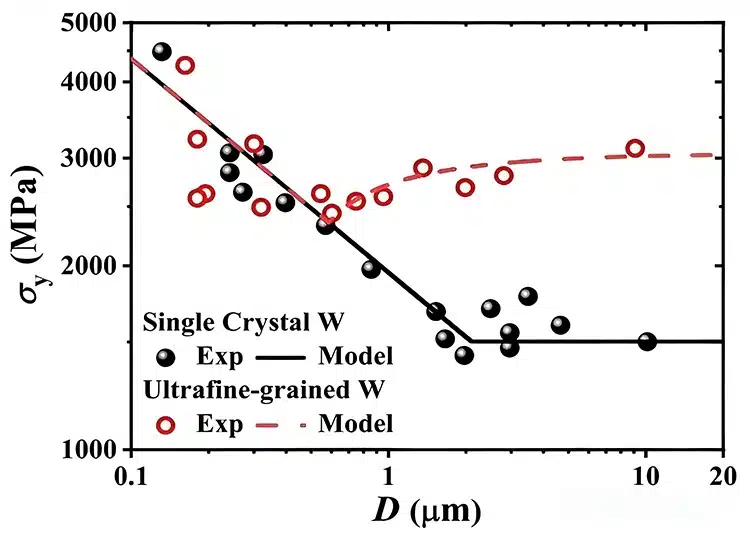
Yield and tensile strength values for materials like aluminum alloys and stainless steel are critical for design decisions. Strength varies with a material’s intrinsic properties and the forces it encounters.
Application
High-strength steels are vital for construction beams, bridges, and other load-bearing structures where safety under heavy stress is critical. For example, structural steel grades with high tensile and yield strength, like ASTM A36 and ASTM A992, are commonly used in high-rise buildings and bridges.
Stiffness
Definition
A material’s resistance to deformation under load, determined by the force required to cause a unit of deformation.
Elastic Modulus
Represents a material’s rigidity as the ratio of stress to strain.
Factors Influencing Stiffness
Intrinsic material properties (e.g., elastic modulus), and the cross-sectional shape of the component impact stiffness.
Application
Among various material properties, stiffness is crucial in steel applications where minimal deformation is essential, such as in precision machinery frames or transportation equipment. For instance, automotive components and structural frameworks rely on high-stiffness steels to ensure dimensional stability under load.
Elasticity
Definition
The property of a material to return to its original shape after deforming forces are removed.
Hooke’s Law
In the elastic range, stress is proportional to strain.
Elastic Limit
The point beyond which plastic (permanent) deformation begins.
Application
Elasticity is a key factor in steel used for springs and flexible components, such as leaf springs in vehicles and shock-absorbing elements. This aspect of material properties is particularly critical in dynamic parts, as stainless steel grades with high elasticity, like 17-4 PH, are often used in parts that must revert to their original shape after loading.
Plasticity
Definition
The capacity of a material to undergo permanent deformation without fracturing when subjected to external forces.
Plastic Deformation
Occurs when external forces exceed the elastic limit, causing irreversible change.
Influencing Factors
Plasticity is affected by factors such as temperature, grain size, and crystal structure.
Application
Plasticity is one of the essential material properties for shaping processes in manufacturing. High-plasticity steels are preferred for forming and shaping processes, such as in automotive body panels and kitchenware. Carbon steels with good plasticity, like mild steel (AISI 1018), are widely used in industries where complex shapes are necessary.
Hardness
Definition
A material’s resistance to localized plastic deformation.
Testing Methods
Brinell, Rockwell, Vickers, and Knoop hardness tests measure hardness levels.
Relation to Machinability
Harder materials are often more challenging to machine, though hardness itself differs from tensile strength.
Application
Hardness is critical in wear-resistant applications, such as cutting tools, industrial knives, and gears. Tool steels (e.g., A2, D2, M2) and abrasion-resistant steels (e.g., AR400, AR500) are chosen for their high hardness and wear resistance in demanding environments.
Ductility and Malleability
Definition
- Ductility: The ability of a material to stretch under tensile stress without breaking.
- Malleability: The ability to deform under compressive forces (e.g., hammering or rolling) without cracking.
Influencing Factors
Factors such as grain size, crystal structure, temperature, and purity influence these properties.
Application
These material properties make steel suitable for forming applications requiring extensive shaping, like pipes and pressure vessels. Steels with high malleability, such as AISI 304, are preferred in the food and pharmaceutical industries, where smooth and complex shapes are required to avoid bacterial buildup.
Brittleness
Definition
A brittle material exhibits minimal deformation before fracturing.
Contrast with Ductility
Brittle materials, like glass and cast iron, have an elongation rate under 5%.
Application
While typically avoided in load-bearing applications, brittle steels, such as cast iron, are used for specific parts like machine bases and certain types of valves where minimal deformation is beneficial.
Toughness
Definition
Toughness combines strength and ductility, indicating the energy a material can absorb before fracturing.
Testing Method
The Charpy or Izod pendulum test measures toughness by energy loss.
Relation to Strength
High strength does not guarantee high toughness; material selection requires a balance of strength and ductility.
Application
Toughness is essential in applications like pipelines, oil rigs, and mining equipment that operate in harsh conditions. High-toughness steels like ASTM A516 Grade 70 are preferred in pressure vessels and boilers, where the material must withstand impacts and resist cracking.
Creep
Definition
The slow, progressive deformation of a material under constant stress at elevated temperatures.
Stages
Creep involves an initial rapid elongation, a steady-rate elongation, and eventual fracture.
Influencing Factors
Temperature, stress level, and material type (such as grain size) affect creep.
Application
Creep resistance is crucial in steel used at high temperatures, such as in power generation and petrochemical industries. Heat-resistant alloys like Inconel 625 and austenitic stainless steels (e.g., 310S, 347) are chosen for their ability to withstand prolonged high-temperature exposure without deformation.
Fatigue
Definition
Failure due to repeated, cyclic loading below the yield strength, leading to eventual cracking and fracture.
Fatigue Strength
The highest stress a material can withstand for an infinite number of cycles without failing.
Impact
Fatigue is a leading cause of mechanical failure, emphasizing the need for materials with high fatigue resistance in cyclic-load applications.
Application
Fatigue resistance is critical for components subjected to cyclic loading, like railway tracks, bridges, and aircraft landing gear. High-fatigue-resistant steels, including certain alloy steels (e.g., 4340) and stainless steels (e.g., 316), are preferred for these applications to prevent failure over repeated use.
Conclusion
In the steel industry, understanding and applying key material properties like strength, stiffness, elasticity, and plasticity is essential for engineers to ensure safety, durability, and performance. With the right insights, professionals can make informed decisions for high-demand applications, from high-rise construction to precision machinery and pressure vessels.
For expert guidance and tailored material solutions, explore our resources at AlloyXpert and let’s build safer, stronger, and smarter together!
Read More:
Analysis and Handling of Transverse Ridges on Steel Coils
Case Study: Why Super Duplex Stainless Steel is the Most Economical Choice for Chimney Construction?