
Introduction
Incoloy 800 is a nickel-iron-chromium alloy designed for high-temperature environments, offering resistance to oxidation, carburization, and sulfidation. It is widely used in industries such as petrochemicals, power generation, and aerospace, performing well in both oxidizing and reducing conditions. This article explores its chemical composition, mechanical properties, corrosion resistance, applications, and how it compares to other alloys.
What Is Incoloy 800 Material?
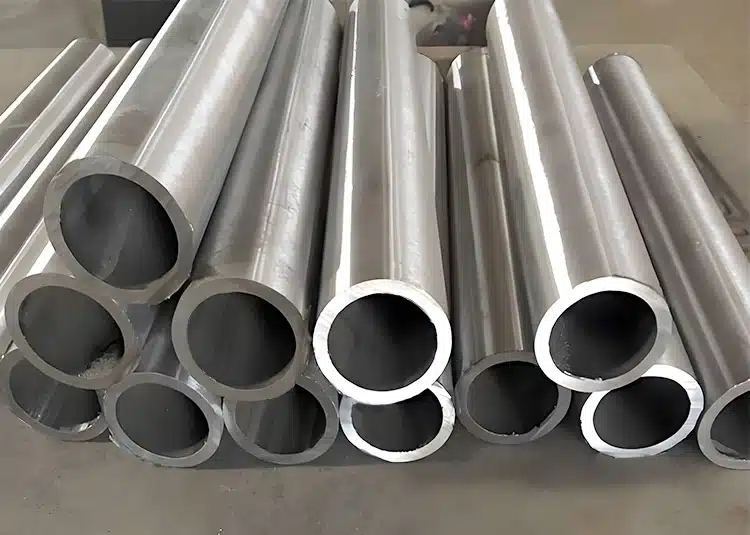
Incoloy 800 is a nickel-iron-chromium alloy known for its high-temperature strength and resistance to oxidation and corrosion. It is widely used in industries like petrochemicals, power generation, and heat treatment equipment, where stability and durability at temperatures up to 1100°C are essential. Its balanced composition makes it ideal for demanding applications in harsh environments.
What Are the Key Properties of Incoloy 800?
Chemical Composition
| Element | Composition (%) |
| Nickel (Ni) | 30.0 – 35.0 |
| Chromium (Cr) | 19.0 – 23.0 |
| Iron (Fe) | 39.5 minimum |
| Carbon (C) | 0.10 maximum |
| Manganese (Mn) | 1.5 maximum |
| Silicon (Si) | 1.0 maximum |
| Copper (Cu) | 0.75 maximum |
| Sulfur (S) | 0.015 maximum |
| Aluminum (Al) | 0.15 – 0.60 |
| Titanium (Ti) | 0.15 – 0.60 |
ASTM Standard
| Bars and Rods | Plates, Sheets, and Strips | Seamless Pipe and Tube | Welded Pipe | Welded Tube |
| ASTM B408 | ASTM B409 | ASTM B407 | ASTM B514 | ASTM B515 |
Mechanical Properties
| Property | Value |
| Tensile Strength (MPa) | 520 minimum |
| Yield Strength (0.2% offset, MPa) | 205 minimum |
| Elongation (%) | 30 minimum |
| Hardness (Brinell) | 170 maximum |
| Modulus of Elasticity (GPa) | 196 |
| Density (g/cm³) | 7.94 |
| Melting Range (°C) | 1357 – 1385 |
Corrosion Resistance
Incoloy 800 provides excellent corrosion resistance in high-temperature environments, thanks to its nickel, iron, and chromium composition. It resists oxidation, carburization, and sulfidation, performing well in both oxidizing and reducing conditions. The alloy is durable against corrosive substances like nitric and sulfuric acids and resists stress corrosion cracking and chloride-induced corrosion, making it ideal for demanding industrial applications.
High-Temperature Performance
Incoloy 800 excels in high-temperature environments, maintaining strength and stability up to 1100°C. It resists oxidation, scaling, and carburization, while retaining key mechanical properties like tensile strength and creep resistance. This makes it ideal for applications such as furnaces, heat exchangers, and petrochemical processing, offering excellent resistance to thermal fatigue and stress corrosion.
What Are the Applications of Incoloy 800?
Marine Industry
Due to its resistance to high-temperature oxidation, incoloy 800 is ideal for marine environments, particularly in:
- Exhaust systems
- Heat exchangers
- Boilers and piping systems
Chemical Processing
Incoloy 800 excels in chemical plants due to its resistance to corrosion and high temperatures, used in:
- Reactors and pressure vessels
- Heat exchangers and evaporators
- Piping systems
Petrochemical and Refining Industry
Incoloy 800 is widely used in the petrochemical and refining industries for components such as:
- Reformer tubes
- Furnace components
- Piping systems
Power Generation and Nuclear Reactors
Incoloy 800 is a preferred material in power generation and nuclear applications, commonly used in:
- Heat exchangers
- Steam generators
- Nuclear reactor components
Automotive and Aerospace Industries
Incoloy 800’s high-temperature stability makes it suitable for applications in:
- Automotive exhaust systems
- Aerospace engines
Incoloy 800 vs. Other Alloys
Incoloy 800 vs Incoloy 825
Incoloy 800 excels in high-temperature applications, while incoloy 825 offers better corrosion resistance, particularly in acidic environments. Incoloy 825 is more suitable for chemical processing where resistance to sulfuric acid is essential.
Incoloy 800 vs Inconel 600
Incoloy 800 is preferred for long-term high-temperature stability, whereas inconel 600 provides superior resistance to chloride-ion stress corrosion and oxidation, making it better for certain chemical environments.
Incoloy 800 vs Stainless Steel (304/316)
Incoloy 800 performs better in extreme heat and chemically aggressive conditions, while stainless steel (304/316) is ideal for general corrosion resistance in lower temperature applications.
Incoloy 800 vs Hastelloy C276
Incoloy 800 excels in high-temperature environments, offering stability and resistance to oxidation and carburization. Hastelloy C276, however, provides superior resistance to aggressive chemicals, including chlorides and strong acids, making it more suitable for highly corrosive environments.
Conclusion
Incoloy 800 is a high-performance nickel-iron-chromium alloy known for its strength and resistance to oxidation, carburization, and sulfidation in high-temperature environments. Ideal for industries like petrochemical, power generation, and aerospace, it delivers reliable durability in harsh conditions. For premium incoloy 800 materials, contact AlloyXpert today for a quote and expert support.
Read More:
What Is Hastelloy C276 (UNS N10276)?
Inconel 600 VS Incoloy 800: The Key Differences You Should Know