
Introduction
The heat treatment of steel is a fundamental process in metallurgy, aimed at altering the material’s properties to meet specific industry requirements. By controlling the heating and cooling cycles, steel can be tailored for a wide range of applications, from automotive parts to construction materials. Heat treatment processes like hardening, annealing, and tempering enhance qualities such as strength, durability, and machinability.
The purpose of steel heat treatment is to optimize the material for specific uses by modifying its internal structure. Whether to increase wear resistance, improve toughness, or refine microstructure, each heat treatment process serves a distinct function. Understanding the role of heat treatment in steel properties is crucial for industries like automotive, construction, and manufacturing.

In this article, we will explore the various purposes of heat treatment of steel, its key benefits, and how it impacts industries relying on high-performance materials.
Why is Heat Treatment Important for Steel?
How Does Heat Treatment Improve Steel Properties?
Heat treatment significantly influences the mechanical properties of steel. By altering the steel’s microstructure, it becomes possible to tailor its strength, hardness, ductility, and toughness. For instance, processes like annealing soften steel to improve machinability, while hardening increases wear resistance and tensile strength.
Key Heat Treatment Methods for Steel
There are several commonly used heat treatment methods, each serving a specific purpose in altering steel’s properties:
- Hardening: Increases strength and wear resistance by transforming the steel into a martensitic structure.
- Tempering: Reduces brittleness after hardening while maintaining the steel’s hardness.
- Annealing: Softens steel, improves ductility, and reduces internal stresses.
- Normalizing: Refines grain structure, increasing toughness and ensuring more uniform mechanical properties.
During hardening, steel is heated to a high temperature, typically between 800°C to 900°C, and rapidly cooled by quenching in water or oil. This rapid cooling forms a martensitic microstructure, which is extremely hard but also brittle. To counter this, tempering is performed at lower temperatures (around 200°C to 600°C) to relieve stresses and reduce brittleness, making the steel suitable for applications requiring high strength without excessive brittleness.
Key Takeways: Heat treatment of steel is an essential process that allows manufacturers to achieve the ideal combination of strength, durability, and flexibility in steel, ensuring it meets the rigorous demands of various industrial applications.
What Are the Main Benefits of the Heat Treatment of Steel?
Improving Steel’s Durability with Heat Treatment
One of the main purposes of heat treatment is to increase steel’s durability, making it more resistant to wear, corrosion, and fatigue. Steel components exposed to harsh operating conditions, such as in the automotive and construction industries, benefit greatly from heat treatment, which extends their service life and reduces maintenance costs.
Influencing Steel’s Machinability Through Heat Treatment
Heat-treated steel is easier to machine, especially when processes like annealing are used to soften the material. Softer steel allows for more precise machining, enabling manufacturers to produce components with tight tolerances and smoother finishes. This is particularly beneficial in precision engineering and tool manufacturing.
For instance, annealed steel has a refined microstructure that improves its ductility and reduces hardness, making it more suitable for processes like milling and turning. In contrast, normalizing results in steel with improved toughness and uniform properties, ideal for high-stress components like gears or axles, where both strength and fatigue resistance are critical.
Key Takeways: Through heat treatment, steel becomes more adaptable to manufacturing needs, whether it’s improving machinability for complex shapes or enhancing its durability in demanding environments.
How Does Heat Treatment Affect Steel’s Microstructure?
Changes in Steel’s Crystal Structure During Heat Treatment
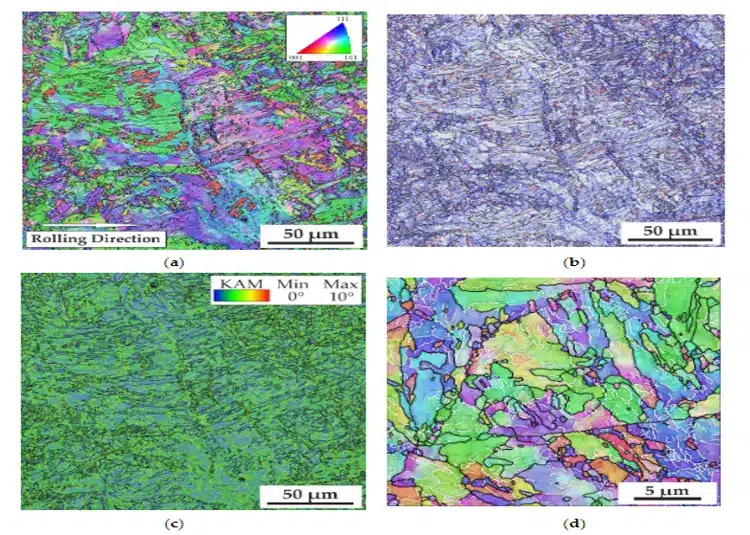
The microstructure of steel is a key factor in determining its properties. Heat treatment alters the grain size and phase distribution within the material, which in turn affects its strength, toughness, and resilience. For example, quenching produces a fine-grained martensitic structure, while tempering restores some ductility.
Impact of Cooling Rate on Steel’s Final Structure
The cooling rate during heat treatment has a profound impact on the resulting structure of the steel. Rapid cooling can lead to the formation of martensite, while slower cooling produces pearlite or bainite, each with distinct properties. The cooling rate must be carefully controlled to avoid undesirable changes like warping or cracking.
For example, martensite is formed through rapid cooling and results in high hardness but low toughness, making it suitable for wear-resistant applications like cutting tools. On the other hand, bainitic steel, which is produced through slower cooling rates, offers a balance between strength and toughness, ideal for heavy machinery components.
Key Takeways: By precisely controlling the cooling rate and temperature, manufacturers can tailor the microstructure of steel to suit the performance requirements of specific applications, ensuring optimal results.
What Are the Challenges in Heat Treating Steel?
Risks of Overheating Steel
Overheating during heat treatment can cause the grain structure to become too coarse, compromising the steel’s mechanical properties. If the temperature exceeds the recommended range, it can also lead to cracking or other defects that weaken the material.
Residual Stresses Affect Heat-Treated Steel
Residual stresses can form during heat treatment due to uneven cooling. These stresses can cause warping or even cracking in the steel, especially in large or complex components. To mitigate this, processes like stress relieving are performed after heat treatment to reduce internal stresses.
Steel components undergo various phases during heat treatment, and controlling the cooling rate is essential to minimize the risk of residual stresses. Tempering, which follows hardening, is a critical process to stabilize the structure and relieve internal stresses that could otherwise lead to premature failure.
Key Takeways: Effective management of heat treatment processes, including cooling rates and temperature control, is crucial to ensure the steel’s final properties meet the required standards and function as expected in demanding applications.
Conclusion
The heat treatment of steel is important for optimizing its mechanical properties for specific uses. Through methods like hardening, tempering, and annealing, manufacturers can significantly enhance the steel’s strength, toughness, and machinability, making it suitable for industries like automotive, construction, and tool manufacturing.
To ensure you’re using the best heat-treated steel for your applications, explore our range of high-performance steel alloys. Contact Alloyxpert today for more information on how our heat treatment services can improve the quality and durability of your products.
FAQs
What is the best heat treatment for steel?
The best heat treatment of steel depends on what you need. Hardening is best for increasing strength and wear resistance. Tempering reduces brittleness after hardening, and annealing makes steel softer and easier to work with. For tough parts, a mix of hardening and tempering works well.
What happens if you heat treat steel for too long?
If steel is heated for too long, it can become too soft or even brittle. The grain structure may grow too large, weakening the steel, and it may crack or warp. Overheating can also cause damage to the surface.
What is the difference between annealing and tempering?
Annealing heats steel to soften it, improve ductility, and reduce stresses, making it easier to work with. Tempering is done after hardening to reduce brittleness, making steel tougher while keeping it strong.