
Introduction
Hastelloy B2 is a high-performance nickel-molybdenum alloy that excels in reducing environments. Known for its outstanding resistance to hydrochloric acid, sulfuric acid, and other aggressive chemicals, Hastelloy B2 is a popular choice in industries like chemical processing and manufacturing. Its unique combination of chemical durability and mechanical strength makes it indispensable for applications requiring reliability under extreme conditions.
Whether you need corrosion resistance for heat exchangers or weldability for complex equipment, B-2 offers unparalleled performance. Let’s dive into its technical details, applications, and advantages.
What Is Hastelloy B2?
Hastelloy B2 (UNS N10665) is a nickel-molybdenum alloy designed for applications requiring excellent resistance to reducing environments. Its ability to withstand strong acids, including hydrochloric acid, makes it a preferred choice for industries such as chemical processing, pharmaceuticals, and energy.
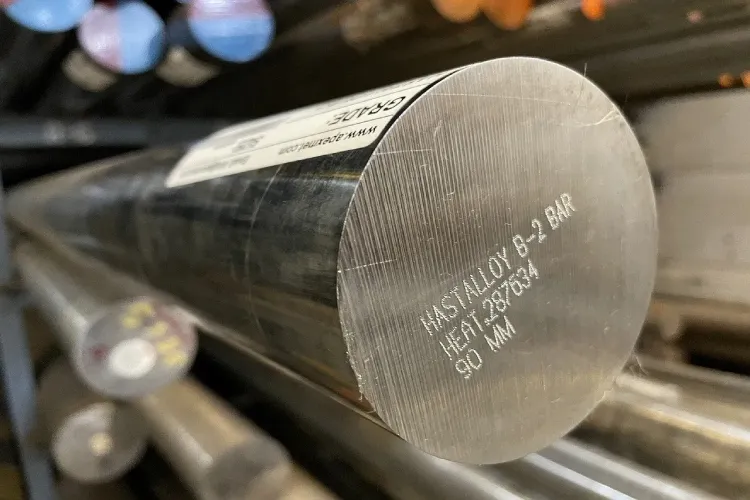
Hastelloy B2 Datasheet
Hastelloy B2 Chemical Composition
| Element | Percentage (%) |
| Nickel (Ni) | Balance |
| Molybdenum (Mo) | 26.0 – 30.0% |
| Iron (Fe) | ≤ 2.0% |
| Chromium (Cr) | 1.0% max |
| Cobalt (Co) | 1.0% max |
| Carbon (C) | 0.02% max |
| Manganese (Mn) | 1.0% max |
| Silicon (Si) | 0.1% max |
| Phosphorus (P) | 0.04% max |
| Sulfur (S) | 0.03% max |
Hastelloy B-2 ASTM Specification
| Product Form | ASTM Specification |
| Plates and Sheets | ASTM B333 |
| Bars and Rods | ASTM B335 |
| Seamless Pipes | ASTM B622 |
| Welded Pipes | ASTM B619 |
| Welded Tubing | ASTM B626 |
Hastelloy B2 Mechanical Properties
| Property | Value |
| Tensile Strength | 110 ksi (758 MPa) |
| Yield Strength (0.2%) | 51 ksi (350 MPa) |
| Elongation (%) | Min. 40% |
| Hardness | Max. 160 HB |
Hastelloy B–2 Physical Properties
| Property | Value |
| Density | 9.24 g/cm³ |
| Melting Range | 1330–1380°C |
| Thermal Conductivity | 7.9 W/m·K |
| Electrical Resistivity | 1.29 μΩ·m |
Hastelloy B2 Corrosion Resistance
| Corrosive Environment | Resistance |
| Hydrochloric Acid | Resistant at all concentrations and up to 109 °C. Samples showed no significant corrosion after 1000 hours at 80 °C in concentrated HCl. |
| Sulfuric Acid | Good resistance up to 50% concentration below 60 °C. A lined tank stored 30% sulfuric acid at 40 °C for over 5 years with minimal corrosion. |
| Phosphoric Acid | Resistant up to 85% concentration at room temperature. A heat exchanger handling 70% acid at 25 °C maintained integrity for 3+ years. |
| Acetic Acid | Withstands all concentrations up to boiling point. Pipes in a food facility had no corrosion in 2 years of transporting acetic acid. |
| Chloride-induced Stress Corrosion Cracking | Highly resistant. Condenser tubes in a coastal power plant showed no cracking after 10 years with seawater cooling. |
| Pitting and Crevice Corrosion | Good resistance in various media. Fittings in a chemical waste plant had no issues after 8 years. |
Note: B-2 is not recommended for use in oxidizing conditions as it may suffer rapid corrosion.
B2 Hastelloy Alloy Fabrication and Heat Treatment
| Process | Details |
| Machining | Use carbide tools with 30 – 50 m/min cutting speed and 0.1 – 0.3 mm/rev feed for turning. |
| Welding | GTAW – 100 – 150 amps, 10 – 15 cm/min speed with ERNiMo-10 filler wire. GMAW – 8 – 12 m/min wire feed, 20 – 25 volts. |
| Heat Treatment | Solution anneal at 1040 – 1090 °C for 1 – 2 hours, then rapid quench in water or water-air mix to enhance properties and homogenize microstructure. |
What Are The Advantages of B2 Hastelloy Alloy?
- Exceptional Corrosion Resistance: Protects against hydrochloric acid, sulfuric acid, and other reducing agents, ensuring durability in aggressive chemical environments.
- High Thermal Stability: Maintains mechanical strength and resistance at elevated temperatures, making it ideal for heat exchangers and reactors.
- Superior Weldability: Easily welded with minimal risk of cracking, allowing for reliable fabrication of pressure vessels, pipes, and other components.
What is Hastelloy B-2 Used For?
- Chemical Processing: Reactors, heat exchangers, and storage tanks.
- Pharmaceuticals: Equipment exposed to reducing chemicals.
- Energy Sector: Piping, tubing, and pressure vessels for harsh environments.
How Does Hastelloy b2 Compare to Other Alloys?
Hastelloy b2 vs b3
Hastelloy B-2 is an excellent choice for handling aggressive reducing agents like hydrochloric acid, but Hastelloy B-3 offers added benefits. B-3 has better resistance to localized corrosion and is less likely to become brittle under thermal cycling. This makes it more suitable for environments with mild oxidizing conditions or temperature fluctuations. However, if you’re working in strictly reducing environments, Hastelloy B-2 remains the more cost-effective option while delivering reliable performance.
Hastelloy b2 vs c276
When comparing Hastelloy B-2 to C-276, the key difference is in their versatility. Hastelloy B-2 is optimised for reducing environments, such as those involving concentrated hydrochloric acid. In contrast, Hastelloy C-276 is designed to handle both reducing and oxidizing agents, thanks to its higher chromium and tungsten content. This makes C-276 a better fit for industries like wastewater treatment, where conditions vary. However, Hastelloy B-2 is more economical for specific reducing environments, making it a practical choice for chemical processing and heat exchangers.
Conclusion
Hastelloy B-2 stands out as a reliable and versatile material, particularly in chemical processing and heat exchanger applications. Its exceptional corrosion resistance and durability make it a preferred choice for engineers and manufacturers.
Ready to explore how Hastelloy B-2 can benefit your project? Contact Alloyxpert today for expert advice or to get a quote tailored to your needs!
Read More: