
Introduction
Discover how engineers apply diameters, thicknesses, and weights in the SS Pipe Weight Chart. They range from 1” and 2” pipes with WT as well as OD. This blog is helpful when it comes to choosing the right pipes for projects. Lengths and densities are also significant.

What is an SS Pipe Weight Chart?
An SS Pipe Weight Chart explains the weight of the pipes made of stainless steel (SS). There is variation in the weight of each pipe size. For instance, a 1-inch pipe might weigh 1.5 kg/m. It would be possible to have a 2-inch pipe with a density of 2.7 kg/m.
They come with sizes, weights, and lengths listed. The chart proves useful in selecting pipes for projects. Pipe type is also important, for example, Schedule 40 or Schedule 80 pipe walls.
It directs the engineers and builders. The construction of this chart aids a lot. It is important to know the weight of the pipe since it maintains safety. That makes projects sturdy and stable. It is very important in the preparation of building plans.
How to Read an SS Pipe Weight Chart?
Column Titles
The chart shows pipes. One of the columns is “Outer Diameter” or “OD” for short. Another says “Wall Thickness” (WT). Of course, this chart also has “Length” and “Weight”. Details of pipes are given in successive columns of the SS Pipe Weight Chart. Every title has a story to tell.
Numbers and letters help. They tell what size and weight pipes are. This makes picking pipes easy. This has the effect of showing that different pipes exist for different purposes.
Row Definitions
Look at the rows. They have pipe info. The first row contains Outer Diameter (OD) as one of its labels. Another has Wall Thickness (WT). The SS Pipe Weight Chart has two rows for length and weight.
Every row describes one pipe in details. They exhibit dimensions of size and weight. They assist in selecting the right pipe. Each one is special. It makes selection as simple as child’s play.
Unit Measures
Units help measure pipes. Length is in meters (m). Weight is in kilograms (kg). Outer Diameter (OD) is in millimeters (mm). Another parameter depicted in the SS Pipe Weight Chart is the Wall Thickness (WT) which is measured in millimeters (mm). These units refer to size and mass. Figures represent how large or heavy pipes are. This aids in the selection of the best one. It makes comparing easy.
Material Grade
Pipes have grades. Grade shows strength. One grade is 304. Another is 316. They describe how strong pipes are. The following grades are present in the SS Pipe Weight Chart.
This is because each grade has its own strength. It assists in the right pipe selection. Each grade is special. This makes picking easy. Each pipe is made for a specific task.
Pipe Dimensions
Pipes come in sizes. One size is Outer diameter (OD). Another is Wall Thickness (WT). Length is also a size. It explains how many hours pipes are. You can see all these sizes in the SS Pipe Weight Chart.
It should be noted that pipes that are used for transportation are of different shapes. This aids in selecting the best one. Sizes are good to go to make pipes fit nicely. Each pipe is unique.
Weight Per Unit Length
Again, weight per unit length is critical. It indicates how much weight is required for one meter of pipe. This is illustrated in the SS Pipe Weight Chart. It is measured using kilograms per meter (kg/m).
Various pipes have different masses. This assists in the selection of the correct one. Numbers make comparing easy. The weight of every pipe has a history to tell. That assists in choosing the best one.
| Row Definitions | Unit Measures | Material Grade | Pipe Dimensions | Weight Per Unit Length |
| Outer Diameter (OD) | Inches (in) | SS304, SS316 | 1/2″ to 24″ | lbs/ft, kg/m |
| Wall Thickness (WT) | Millimeters (mm) | ASTM A312 | 0.5mm to 10mm | lbs/ft, kg/m |
| Schedule (Sch) | Nominal Diameter | EN 10216-5 | Sch 10, Sch 40, Sch 80 | lbs/ft, kg/m |
| Inner Diameter (ID) | Centimeters (cm) | DIN 17456 | Varies with OD & WT | lbs/ft, kg/m |
| Length | Meters (m) | JIS G3459 | Standard or Custom | lbs/ft, kg/m |
| Pipe Weight | Kilograms (kg) | GOST 9941-81 | Full Length, Cut Length | lbs/ft, kg/m |
| Density | Pounds (lbs) | ASME B36.19M | Consistent Across Grade | lbs/ft, kg/m |
Table on How to Read an SS Pipe Weight Chart!
Why is the SS Pipe Weight Chart Essential for Engineers?
Design Accuracy
Ø2 cm and Ø5 cm are employed by engineers to manufacture pipes. They require specific weights such as 1.2kg and 3.5kg. They use the SS Pipe Weight Chart. It helps to ensure that pipes fit appropriately in CAD drawings. This avoids mistakes. These are 1m and 3m long which are more frequently used.
This chart indicates the right gauges and thicknesses. Perfect designs are achieved using this by engineers.
Load Calculations
It is important to have certain weight knowledge such as 1.5 kg/m and 2.8 kg/m. This is well illustrated in the SS Pipe Weight Chart. In load calculations, it assists engineers.
They compute for 50 N and 100 N loads. This keeps structures safe. These details help avoid overloading. This chart assists engineers to make sure pipes can bear certain weights.
Structural Integrity
For instance, engineers balance weights such as 2 kg/m and 4 kg/m with the help of the SS Pipe Weight Chart. It assists to measure forces of 200N and 500N. The pipes cannot bend.
This makes sure that the structures remain strong. Engineers avoid instances of structures collapsing by using appropriate weights. They base their decisions on such figures. That keeps everything safe.
Material Selection
The chart specifies masses such as 1.5 kg/m of SS304 and 3 kg/m of SS316. Therefore, this SS Pipe Weight Chart is very important in material selection process. Engineers must know which ones to select.
Various alloys alter the weight of. They want to make sure that the material is right for the project. This avoids issues. Sometimes the right choice makes the pipes to work well.
Cost Estimation
Cost estimates are made by engineers in relation to 100 m and 200 m of pipes. Weights for the pipe according to various materials can be seen through the SS Pipe Weight Chart. This helps plan budgets.
They determine the cost for SS304 and SS316. It is crucial to know weights as it influences the transportation and installation costs. This one is used for cost control by engineers. It manages the cost in projects.
Compliance Requirements
Engineers refer to weights such as 1.2 kg/m and 2.5 kg/m to rules. The SS Pipe Weight Chart provides assurance that pipes have the required standard. This helps pass inspections.
It’s also used by engineers to manage penalties. They need accurate weights. This keeps projects legal. Thus, compliance is vital to ensure safety. That is why they turn to the chart.
How to Calculate SS Pipe Weight Using the Chart?
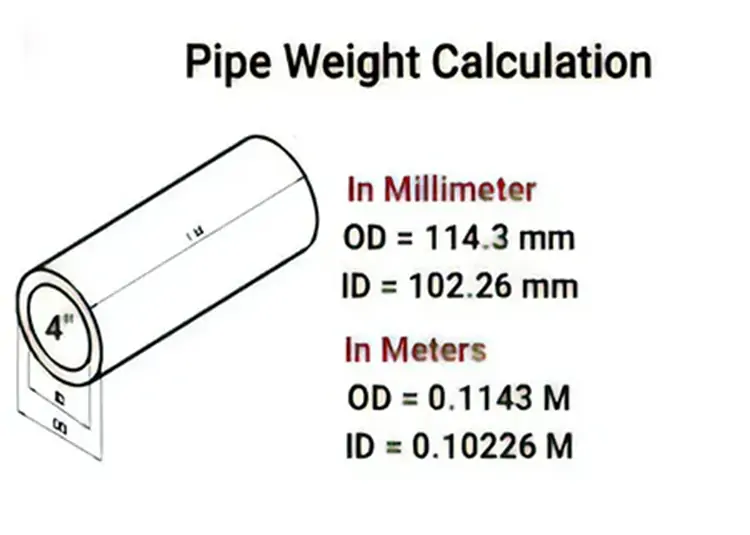
Formula
To find pipe weight, use this formula: W = π (D² – d²) L ρ / 4. D is outer diameter, d is inner diameter. π is 3.1416. ρ is density. L is length. This ensures correctness in calculations. It is used in the SS Pipe Weight Chart. Ensure that units are consistent, for instance millimeters for diameters and length.
Density is calculated in g/cm³. Convert result to kg. Ensure that the right values have been used in the formula. This formula is required for different pipes. It’s easy to follow, and makes calculations simple.
Inner Diameter
It is also very important to note inner diameter (d). Take measurements from one internal wall to another. Larger diameters imply more flow, for example, a pipe of 25 mm diameter. This should be done using a vernier caliper. The SS Pipe Weight Chart requires this value. Makes weight right.
The pipes also vary in inner diameter. Look for each in the chart. Inner diameter is key. It assists in selection of the appropriate pipe, and makes calculations easy. It is important for accurate results. Without it, errors happen. Inner diameter ensures precision.
Outer Diameter
One of the most critical factors is outer diameter (D). Take from one outer wall to another, for instance, a 50 mm pipe. The SS Pipe Weight Chart requires this measurement. Pipes with larger diameters have more mass than those that have small diameters. Use a tape measure.
It is important to note that various types of pipes have different outer diameters. See the chart for each. It impacts weight directly. This is why outer diameter is important, and even aids in identifying the appropriate pipe to use. Each pipe type varies. The outer diameter is significant. Use precise measurements. This makes calculations right.
Pipe Length
Pipe length (L) is important. Measure the entire pipe. Length affects weight. A 2-meter pipe is typical. The SS Pipe Weight Chart takes this into account. Longer pipes weigh more. Use a ruler. Enter length in meters. This part is rather easy to measure. Length impacts the chart. It’s a key factor.
One pipe length is different from the other. Length measurement is also crucial since it is used to determine the overall weight of the fabric. Double-check the length. This ensures no mistakes. Length is basic yet significant. It makes calculations right.
Density
Density (ρ) is very important. It’s the mass per volume. Density of SS pipes is 7.85 g/cm³. This value is used in the SS Pipe Weight Chart. With higher density comes the increased weight of the pipes. Use accurate density values. Density of the materials varies from one material to the other.
This makes calculations correct. Density is expressed in grams per cubic centimeter (g/cm³). This is a fixed value for SS pipes. Density impacts weight directly. When using density incorrectly, it is impossible to make the right calculations. This parameter is critical for the chart, and ensures that the weight is correct. Density is one of the factors.
Example Calculations
This is illustrated through example calculations. For example, D =50 mm, d =40 mm, L =2 meters, ρ =7.85 g/cm³. Use the formula: W = (π× (50²-40²) ×2×7.85)/4. Result is about 24.7 kg.
These numbers are used in the SS Pipe Weight Chart. Examples make it clear. Follow each step. Use the right units. These numbers are typical. They assist in comprehending the chart.
Example calculations guide you. This ensures that the weight is correct. Different scenarios are shown. Examples are very helpful. They ease the process.
What are the Standard Sizes in an SS Pipe Weight Chart?
Nominal Sizes
Pipes range from 1/8 of an inch to 72 inches in diameter. These sizes aid in selecting the right pipe. For instance, a 1/2″ pipe has 0.84″ width. This is known as the nominal size. Industries and engineers for instance use it to ensure pipes fit or interconnect correctly. In an SS Pipe
Weight Chart, the width of a pipe labeled as 4” is 4.5”. The nominal size ensures easy ordering of pipes. Pipes have to fit together properly, and this aids.
Schedule Numbers
Pipes come with schedule numbers such as SCH 40 and SCH 80. This indicates how thick the wall of the pipe is. Thicker walls also have a strong way of making the pipes themselves.
For instance, SCH 80 pipes are heavier than SCH 40 pipes. These numbers are used by engineers in selection of pipes. The SCH 10 pipes are the thinnest in an SS Pipe Weight Chart. These numbers are very crucial in various careers. This helps keep things safe.
Wall Thickness
Thickness is the measurement of strength of the pipe. They vary between 0.035 inches and 1.25 inches. Thick walls are capable of bearing more load as opposed to thin ones. For instance, the walls of 0.5” thickness are extremely sturdy. Engineers consider pipe wall thickness while selecting pipes.
In an SS Pipe Weight Chart, it will be seen that thick pipes are used in difficult and hard working conditions. They also make pipes heavier as a result of the thickness of the wall. This helps pipes to have a long life span.
Diameter Ranges
It has pipes ranging from ½” to 24”. This is how they are when they are wide. A 6” pipe is not the same thing as a 12” pipe. Engineers decide with what they require.
For instance, in the SS Pipe Weight Chart, most of the small pipes go to homes. Large pipes are for industrial purposes. The consequences are that diameter influences what can fit through. It ensures that things are set right.
Common Standards
Pipes must be conforming to standards such as ASTM, ASME, and ANSI. These rules also ensure that pipes are of good quality. ASTM A312 describes the manner in which pipes should be ASME B36.19 indicates pipes dimensions. ANSI ensures that the parts fit one another well.
These standards are useful in an SS Pipe Weight Chart and they ensure that pipes are safe. These are rules that engineers adhere to in the creation of structures. This prevents pipes from getting damaged.
Availability
Tubes can be purchased in various diameters. These include 1”, 2”, 3”, 4”, 5”, 6”, 8”, 10”, and 12”. If it comes to special sizes they require specific orders only. Various types like 304 or 316 are used.
In an SS Pipe Weight Chart, there are so many schedules that include SCH 10 and SCH 40. Engineers see what is configurable for their projects. This assists in completing tasks within a given timeframe. The principle of availability impacts cost and time.
Where Can You Find Reliable SS Pipe Weight Charts?
Manufacturer Websites
Try to find their charts and graphs on manufacturers’ websites. A 1-inch pipe can weigh 2.68 pounds per foot. They represent sizes and grades such as 304 SS. Go to the “Materials Section” to get the information. This helps you select the appropriate pipe.
Wuxi Chengjiu Metal offers comprehensive stainless steel pipe data. SS Pipe Weight Chart contains figures. The sizes, such as 2-inch, are different in weight. It is useful in project planning. Charts help one select the right pipe. Proportions and measurements do count. Engineers need this info. Manufacturer sites also assist in determining the best pipes to use.
Industry Publications
Industry books have charts. Thus, a 2-inch pipe can weigh 3.79lbs/ft. They come in sizes and grades such as 316L. This is because engineers require them for planning purposes. SS Pipe Weight Chart is beneficial for them. It also comes in different sizes and weights as shown below.
This ensures correct materials. Such words as Schedule 10 can be regarded as technical words. Chengjiu Metal provides detailed industry publications and charts. They show precise info. Sizes and thicknesses matter. Publications give accurate data. Engineers trust this info.
It assists them in deciding which pipes they should use. Every detail is important. Industry books can be regarded as authoritative sources.
Technical Standards Organizations
Standards groups offer charts. An equivalent 3-inch pipe weighs 7.58 lbs/ft. It gives sizes and grades such as 304 SS. Weight chart of SS pipe is available here. This is used by engineers and mostly in their projects. Chengjiu Metal follows industry standards for SS pipe weights.
It selects the proper pipe by size and weight. Standards ensure quality. Some of the terms used are technical such as Schedule 40. They show accurate details. Engineers need precise info.
This assists in the construction of structures. Each chart is detailed. Organizations update them. They trust these charts. Accurate info is key. Standards groups are reliable.
Engineering Handbooks
Handbooks have charts. Pipe with 4-inch diameter has a weight of 10.79 lbs per running foot. They display standard sizes and grades including 316L. Engineers use this info.
SS Pipe Weight Chart assists in the selection of the right SS pipe. Dimensions and measures are given in terms of length, width, height, and mass. Wuxi Chengjiu Metal includes engineering handbooks for reference. They use terms such as Schedule 80. Engineers need precise data.
This helps in planning. Each size is important. Handbooks are trusted. They provide accurate info. Engineers rely on this. Charts help in projects. Handbooks are essential tools. They are full of useful info.
Online Databases
Databases have charts. Pipe having a diameter of 5 inches would weigh approximately 14.62 lbs per foot. They depict dimensions and classes such as 304 SS. Engineers use this info. Stainless Steel Pipe Weight Chart is very much available. Our company’s online databases are updated often for accuracy.
Measures are given in terms of size and weight. Databases update often. It is easy for them to access. Engineers trust them. Phrases like Schedule 10 are used.
This info aids in the selection of the appropriate pipe to use. Every detail matters. Engineers need precise data. Databases are reliable. They help in planning. Mass and volumes are crucial. Online sources are important.
Professional Associations
Associations give charts. Pipe 6 inches in diameter has a weight of 18.97 lbs per foot. They come in sizes and grades such as 316L. Engineers use this info. SS Pipe Weight Chart makes it easier to select the right pipe. Dimensions are given in terms of size and weight. Associations update often.
Chengjiu Metal collaborates with professional associations for reliable data. Some of the terms they use include Schedule 40. Engineers trust this info. It helps in planning. Every detail is crucial.
Sizes and weights matter. Associations provide accurate data. These charts are familiar to engineers. They ensure quality. Associations are key sources. They contain a lot of information that is quite helpful.
Conclusion
The SS Pipe Weight Chart is used by engineers to verify sizes and weights. It also assists in the selection of pipes. Find charts on ALLOYXPERT. Proper decisions make projects safe. Visit now to know more about pipes, sizes and weights.
Read More:
Mastering SS Pipe Weight Calculations!